
The first time I trained at home, I had no idea what I was doing. I had just cancelled a $50 gym membership that wasn’t working for me, opened a notebook, and pieced together a home workout plan from a few articles I had bookmarked. That first session was 60 minutes of pure self-doubt — four rounds of a 12-minute bodyweight circuit (push-ups, planks, sit-ups, jumping jacks, and a 30 second plank hold), with three minutes of rest between rounds. By the end, I was lying on the floor wondering whether I’d just done something useful or embarrassed myself.
This article contains affiliate links. If you buy throughthese links, I may earn a small commission at no extra costto you. I only recommend products I personally use and trust.
The next morning my muscles told me the answer. Soreness in places I had ignored for years. That was the day I knew home workouts were going to work — if I stuck with them.
Two years later, I’m in the best shape of my life. And most of that progress came from training routines almost identical to the one I’m about to walk you through. This is a real, structured home workout plan for beginners — built around what actually works for a body starting from zero. Not theory. Not magazine archetypes. Just what worked during two years of beach-and-bedroom training in Rio de Janeiro.
If your goal is to get fit without spending hundreds on gym memberships or fancy equipment, this guide is going to be one of the most useful things you read this month. The only thing I genuinely recommend buying before you start is a decent yoga mat. Push-ups on hardwood floors get old fast, and your knees and elbows will thank you within the first 15 minutes.
Everything else in this plan is bodyweight: your own resistance, your own floor, your own four weeks of commitment. Let’s get into it.
Why a Structured Home Workout Plan Beats Random Sweating
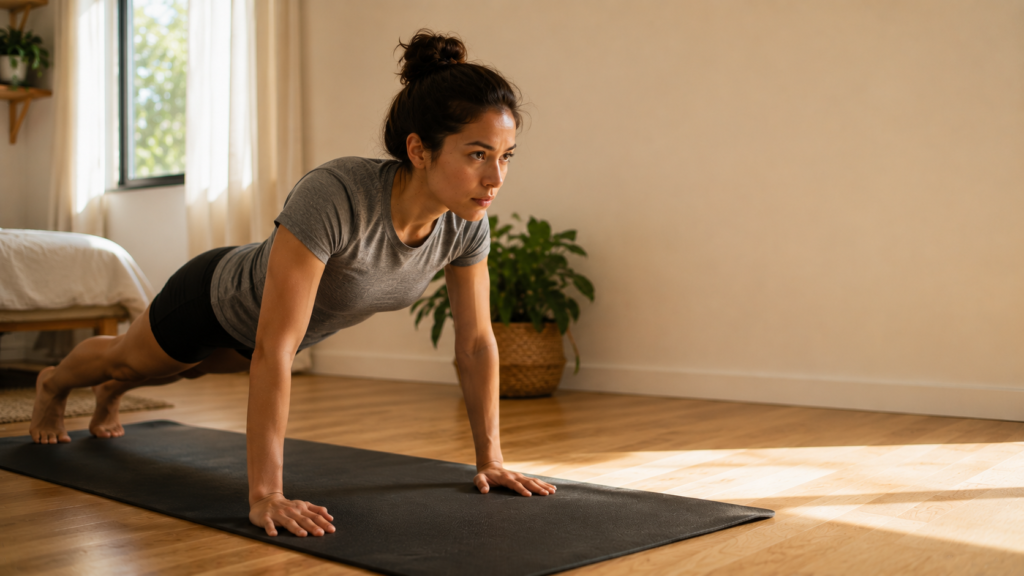
Here’s something I learned the hard way: random exercise doesn’t produce consistent results. You can sweat through an unplanned 25 minutes of jumping around and end up exhausted without having actually trained any specific quality. Cardio, strength, mobility — they all need a slightly different stimulus, and a good plan handles that for you.
The principle that powers every effective home workout plan for beginners is called progressive overload: the gradual increase of stress placed on the body during exercise. With no equipment, you can apply progressive overload by doing more reps, slowing down each rep, reducing rest between sets, or progressing to harder variations of the same movement. This is the entire reason I made progress in my first six months. Without it, I would have been doing the same workout in week 24 as I was in week 1.
Regular physical activity also has benefits well beyond aesthetics. According to the World Health Organization, staying active reduces the risk of chronic disease, improves mental health, and is one of the most important things you can do for your long-term wellbeing. None of that requires a gym membership.
A structured plan also keeps you from making the two most common beginner mistakes: doing too much too soon (which I did — more on that below) and doing the same thing forever. The plan I’m sharing here protects you from both.
What to Expect in Your First Four Weeks of a Home Workout Plan
I want to be honest about what realistic progress looks like, because fitness culture is full of overpromising.
In your first four weeks of a home workout plan for beginners, you’re not going to transform your body. What you will do — and what matters more — is build a habit, improve your coordination, increase your endurance, and notice that exercises that felt impossible in week 1 are manageable by week 3.
Here’s the rough arc of what to expect, based on what happened to me and to several people I’ve passed this plan to:
- Week 1: Everything feels awkward. Your body is sore in places you forgot existed. Form is shaky. Don’t focus on speed or numbers — focus on doing the movements correctly.
- Week 2: Soreness drops sharply. Movements start to feel natural. You’ll notice you can add a rep or two without much extra effort.
- Week 3: Adaptation begins for real. The exercises that felt brutal in week 1 feel routine. You may feel the urge to go harder — resist it for now and trust the plan.
- Week 4: Real differences in endurance and base strength. Time to introduce slightly harder variations.
Three workouts a week, done reliably, will always outperform six sessions that fizzle out by day 10. I learned this the hard way, and I’ll tell you the full story in the mistakes section.
The Core Movements Behind Every Beginner Bodyweight Workout
A well-rounded beginner bodyweight workout hits all major muscle groups: legs, core, chest, back, and shoulders. The exercises below form the backbone of every session in this plan. Practice the form before you worry about reps.
Squats are the foundation of lower-body training. Stand with feet shoulder-width apart, toes slightly turned out. Lower yourself as if sitting into a chair, keeping your chest up and your knees tracking over your toes. Drive through your heels to stand. Start with three sets of ten.
Push-ups are the single best upper-body movement you can do at home. If standard push-ups are too hard, start on your knees or with your hands elevated on a sofa or counter. Keep a straight line from head to hips — no sagging, no piking. Three sets of eight is a strong starting point.
Glute bridges target the posterior chain — the muscles that get neglected when you spend most of your day sitting at a desk. Lie on your back, knees bent, feet flat. Press through your heels and squeeze your glutes to lift your hips. Hold for two seconds at the top.
Plank is the exercise I most underestimated when I started — and I want to flag it specifically because every beginner does the same thing. I thought it was almost a joke movement: lie still, how hard can it be? Then I actually timed myself. I couldn’t hold a real plank for more than 25 seconds without my whole body shaking. Six weeks of consistent training later, I held a clean one-minute plank for the first time, and I genuinely felt prouder of that than of any push-up milestone. Don’t underestimate isometric exercises. The slow build is what teaches you that progress is real even when it’s invisible.
Reverse lunges challenge balance and single-leg strength. Step backward, lower your back knee toward the floor, then return to standing. Alternate legs. They’re harder than they look — that’s the point.
Mountain climbers add a cardiovascular element while loading the core. Start in a high plank position and drive your knees toward your chest in a controlled, alternating motion. Don’t flail — control the pace.
Your Four-Week Home Workout Plan, Week by Week
This is the actual workout plan I followed in my early months, refined over two years of testing what really works for a beginner training at home. Three sessions a week, on alternating days. Each session takes 25 to 30 minutes — warm-up and cool-down included. Run it on Monday, Wednesday, and Friday: that’s the schedule I still use for my heaviest training days.
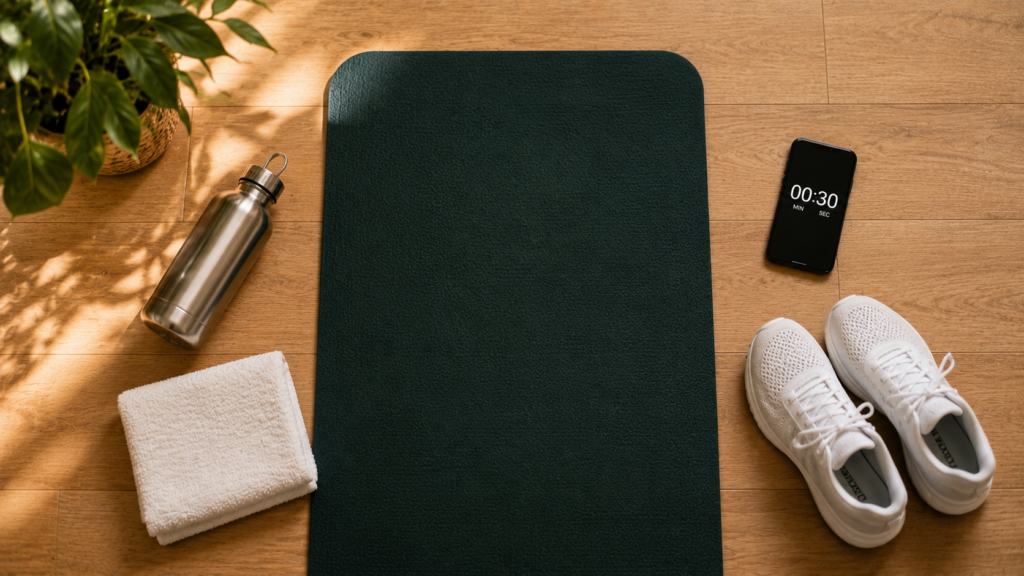
One small detail that changed everything for me: I started timing everything. Sets, rest, transitions. Trying to count “60 seconds” in your head while gasping for air doesn’t work — you’ll either rush the rest or stretch it to 3 minutes. I use a simple interval timer clipped to my shorts: set the work/rest intervals once, hit start, and stop checking your phone every 30 seconds. About $20, lasts forever, and it’s the difference between a real workout and a casual one.
Warm-up (5 minutes, every session): March in place for 1 minute. Arm circles for 30 seconds in each direction. Leg swings for 30 seconds per side. Hip circles for 1 minute. Gentle squat stretch for 1 minute. Don’t skip this — I’ll tell you why in the mistakes section.
Week 1 — Build the Foundation
| Exercise | Sets | Reps / Duration |
|---|---|---|
| Squat | 3 | 10 reps |
| Knee push-up | 3 | 8 reps |
| Glute bridge | 3 | 12 reps |
| Plank | 3 | 20 seconds |
| Reverse lunge | 2 | 8 reps per leg |
Rest 60 to 90 seconds between sets.
Week 2 — Add Volume
| Exercise | Sets | Reps / Duration |
|---|---|---|
| Squat | 3 | 15 reps |
| Knee push-up | 3 | 12 reps |
| Glute bridge | 3 | 15 reps |
| Plank | 3 | 30 seconds |
| Reverse lunge | 3 | 10 reps per leg |
| Mountain climber | 2 | 20 seconds |
Rest 60 seconds between sets.
Week 3 — Increase Intensity
| Exercise | Sets | Reps / Duration |
|---|---|---|
| Squat | 4 | 15 reps |
| Standard push-up | 3 | 8 reps |
| Single-leg glute bridge | 3 | 10 reps per side |
| Plank | 3 | 40 seconds |
| Walking lunge | 3 | 10 reps per leg |
| Mountain climber | 3 | 30 seconds |
Rest 45 to 60 seconds between sets.
Week 4 — Test Your Progress
| Exercise | Sets | Reps / Duration |
|---|---|---|
| Jump squat (or deep squat) | 4 | 12 reps |
| Standard push-up | 4 | 10 reps |
| Single-leg glute bridge | 3 | 12 reps per side |
| Plank | 3 | 50 seconds |
| Lateral lunge | 3 | 10 reps per leg |
| Mountain climber | 3 | 40 seconds |
| Burpee (modified or full) | 2 | 6 reps |
Rest 45 seconds between sets.
Cool-down (5 minutes, every session): Standing quad stretch, seated hamstring stretch, chest opener, and child’s pose for one minute each. Recovery is part of training, not an optional add-on.
Mistakes That Derailed Me (And How to Avoid Them)
Every mistake in this section is one I personally made. Some of them cost me weeks of progress. Knowing about them won’t completely protect you, but they will at least make sure that when you struggle, you’ll recognize the pattern and adjust faster than I did.
Mistake 1 — I tried to train six days a week from day one
This was my biggest beginner error. I wanted fast results, so I assumed more = better. I trained almost every day for the first two weeks, telling myself I was being disciplined. By the end of week 3 my body was so sore that I could barely climb a flight of stairs, and I had stopped seeing progress on any of the exercises. The lesson took a few painful days off training to actually understand: rest isn’t the absence of training. Rest is when your body actually adapts to the work you’ve done. Without it, training is just damage.
After that, I dropped to three sessions per week. Strength came back. Soreness dropped. Performance improved. Today, two years in, my routine is heavy strength work on Monday, Wednesday, and Friday, light or regenerative work on Tuesday and Thursday, and full rest on weekends. That’s the schedule I’d recommend to any beginner who’s been tempted by the “more is more” trap.
Mistake 2 — I increased the load on a back machine without knowing what I was doing
This one happened during my brief stint at the gym, but the lesson applies just as much to home training. I was on a back-machine exercise, decided to add weight without consulting anyone, and felt a sharp twinge mid-rep. I finished the set ignoring it, like an idiot. By the next morning, I had real pain. It got worse for two days, then plateaued. I didn’t train for fifteen days because I was scared of making it worse.
The lesson: never increase resistance, intensity, or difficulty just because you feel motivated. Progress should be gradual and earned. After that injury I made a personal rule: only increase the load — or progress to a harder variation — when I genuinely feel that the current level has become comfortable. I haven’t injured myself since.
For home workouts this means: don’t go from knee push-ups to standard push-ups just because you watched a YouTube short. Earn the progression.
Mistake 3 — Skipping the warm-up because it felt boring
In my first week I skipped the warm-up almost every session. Five minutes of marching and arm circles felt pointless — I just wanted to get to the “real” workout. Two months in, after a long gym session, my lower back gave me a smaller version of the same warning the back machine had: a tight, restricted feeling that took two days to fade.
A warm-up isn’t a stretching ritual. It’s how you tell your nervous system, joints, and muscles that they’re about to be loaded. Five minutes is the cheapest insurance you can buy against injury. Don’t skip it.
Mistake 4 — Sacrificing form for reps
I caught myself doing this in week 2. I was trying to push from 8 push-ups to 12 in a single session, and by rep 9 my hips were sagging halfway to the floor. Ten perfect push-ups will always beat 14 sloppy ones. Bad form doesn’t just reduce effectiveness — it teaches your body bad movement patterns that take longer to unlearn than to never adopt.
If you have access to a mirror or your phone camera, use them. I started filming myself once a week and the form corrections came naturally just from seeing myself.
Mistake 5 — Treating one missed session as a streak-breaker
The first time I missed a Friday workout because of a long workday, I felt like the whole plan had collapsed. That feeling almost made me skip Monday too. Don’t fall for it. A missed session is just a missed session. The plan is the average of your weeks, not the perfection of any one. Show up Monday and don’t think about Friday again.
How to Progress Beyond the Four-Week Plan
Finishing four weeks of a home workout plan for beginners is a real achievement — and a starting line, not a finish line. Once Week 4 sessions feel comfortable, here’s how to keep progressing without buying anything.
Increase time under tension. Slow down your reps. A three-second descent on a squat followed by a two-second pause at the bottom is dramatically harder than a fast squat with no pause. This technique, called tempo training, is one of the most effective ways to make bodyweight exercises tougher without adding weight.
Progress to harder variations. Push-ups can advance from knee → standard → decline → archer → diamond → eventually one-arm. Squats can progress from standard → pause squat → jump squat → Bulgarian split squat → pistol squat. There’s always a harder version waiting when your body is ready.
Add circuits and HIIT. Once your base fitness improves, circuit training (moving from one exercise to the next with minimal rest) and high-intensity intervals (short bursts of all-out effort followed by short rests) become excellent tools. Six exercises, 30 seconds of work and 15 seconds of rest each, three to four rounds — that’s a brutal 20-minute session that will challenge even people who have been training for a year.
Add a flexibility or mobility practice. Yoga and dedicated stretching sessions complement strength training beautifully. They improve range of motion, reduce injury risk, and offer recovery benefits on rest days. Free apps and YouTube channels have plenty of beginner-friendly options.
The point of all of this is to keep building a sustainable practice. Anyone who commits to a home workout routine for six months or more usually reports improvements not just in physique, but in energy levels, sleep, and mental clarity. That’s the long game.
If you’re combining workouts with budgeting your overall fitness costs, my complete guide to getting fit on a budget walks through how I keep my whole monthly fitness spending under €130 — workouts, food, and the occasional gym session combined.
My Current Weekly Schedule (Two Years Later)
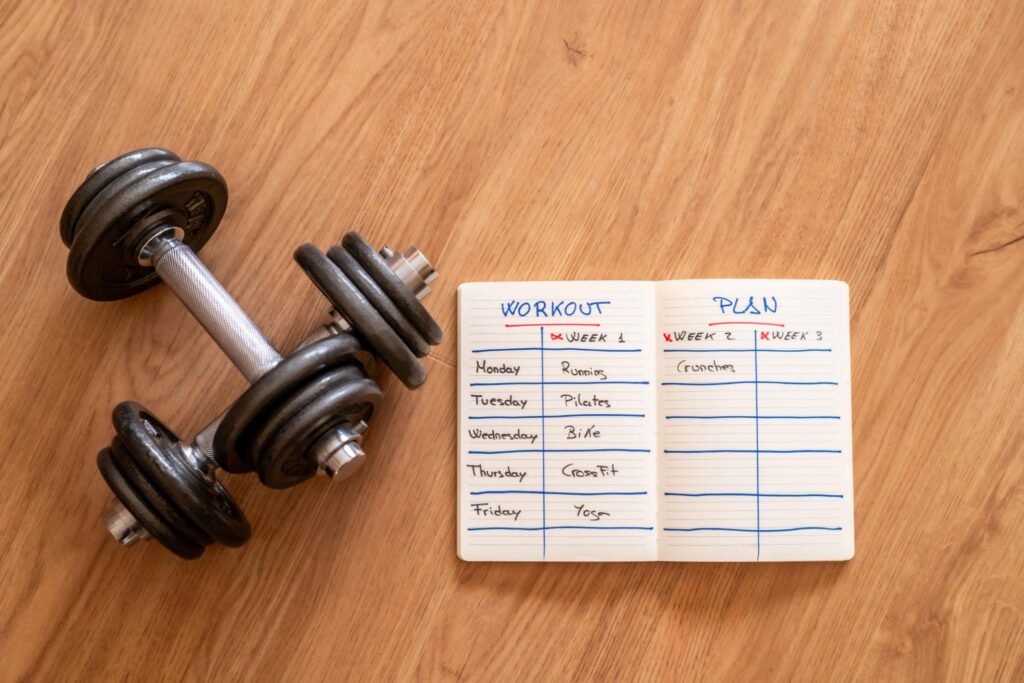
For context — and as a target — here’s what my training week looks like now, two years into consistent training:
- Monday: Heavy session (strength focus, 45 minutes)
- Tuesday: Light or regenerative work (a 25-minute beach run or mobility flow)
- Wednesday: Heavy session (different focus from Monday)
- Thursday: Light or regenerative work
- Friday: Heavy session
- Saturday and Sunday: Full rest, walking, family time
Three heavy sessions, two light sessions, two days of complete rest. This is the rhythm I arrived at after the painful early lesson of overtraining. Yours will look slightly different based on your life — but the principle holds: a structured rotation between hard work, lighter work, and full rest is what makes the body actually adapt instead of just survive.
The Mindset That Makes Your Home Workout Plan Stick
A plan only works if you follow it, and following it is a mental game more than a physical one. Three principles that genuinely helped me:
Patience over intensity. Progress is invisible for the first 2-3 weeks and gradual after that. I went from 25-second planks to 60-second planks over six weeks. I went from 8 knee push-ups to 12 standard push-ups over five weeks. None of that happened overnight, and trying to force it would have ended in injury (as it almost did). Trust the process.
Anchor your sessions to a fixed cue. I always train in the morning, before checking my phone. My coffee is the trigger — when I finish the cup, I move to the mat. Habits form around triggers. Without one, you rely on willpower, and willpower is a finite resource that runs out exactly when you need it most.
Track your numbers, even simply. A note on your phone that logs reps and times each session is enough. After four weeks you’ll be surprised at how far the numbers have moved. Progress is motivating, but only if you can see it.
Talk to yourself like a coach, not a critic. When you’re tired in a set and the voice in your head says “stop”, respond like a good coach would: “Three more, you’ve got this.” Self-talk shapes performance more than people realize.
Frequently Asked Questions
How many days a week should a beginner work out at home?
Three days a week is the sweet spot for the first month. Done with proper form and full effort, that’s enough to stimulate adaptation without exceeding your recovery capacity. If you feel ready, you can introduce a fourth or fifth day in month two — but always add lighter sessions, not more heavy ones. I was overtraining at six days a week as a beginner, and it cost me real progress.
Can I actually build muscle with no equipment?
Yes. Muscle growth requires mechanical tension and metabolic stress, both of which bodyweight exercises produce. You won’t build the same mass as someone training with heavy barbells four times a week, but you’ll absolutely build visible, functional muscle, especially in your first year. After that, adding some basic weights (or going harder on bodyweight progressions) accelerates things.
What should I eat to support my home workouts?
You don’t need a strict diet. Three priorities: enough protein (rough target around 1g per pound of bodyweight if you’re trying to build muscle, less if you’re cutting), enough water, and don’t drastically undereat. Severely cutting calories while starting a new training program usually backfires — performance drops, recovery suffers, and the habit becomes hard to maintain. For a budget-friendly approach, see my guide on eating healthy on a budget.
How long should a beginner workout session be?
25 to 35 minutes is plenty. A focused half-hour is more valuable than a distracted 60 minutes. The plan above is built around this principle. You don’t need long sessions to make progress — you need consistent ones.
What if an exercise hurts?
There’s a critical difference between discomfort (muscle fatigue, the burn of effort, mild post-session soreness — all normal and good) and pain (sharp, joint-specific, alarming — stop immediately). If a specific exercise causes pain, swap it for an easier variation or skip it entirely. For pain that lingers more than a couple of days, see a physiotherapist. I learned this the slow way after my back injury — listen to those signals.
Is it okay to work out every day as a beginner?
It’s not ideal. Recovery is when adaptation happens. Daily training as a beginner usually leads to either burnout or minor injury within four to eight weeks. If you want to do something on rest days, walking, gentle yoga, or stretching are excellent active recovery options. That’s exactly what my Tuesday and Thursday sessions are.
Your Next Step
You now have a real, structured home workout plan for beginners. No equipment, no gym, no commute. Just a piece of floor and 30 minutes a day, three days a week.
Tomorrow morning — or whatever day starts your week — pick a time, lay out a mat (or a folded towel if you don’t have one), and run through the Week 1 session. Don’t worry about perfection. Don’t worry about how it looks compared to someone on Instagram. Just do it.
In four weeks you’ll be a meaningfully different version of yourself, and the building blocks of a real fitness practice will be in place.
If movement is the first piece you wanted to fix, you’re now set. Two more pieces to handle alongside this home workout plan: nutrition and overall budget. Read how to eat healthy on a budget next — eating well is what makes the workouts actually translate into results — and the cheap meal prep guide for beginners if your weakest point is finding the time to cook.
— Gabriel Founder, Fit Budget Life
Pingback: How to Get Fit on a Budget (Beginner Guide)
Pingback: How to Eat Healthy on a Budget (Beginner Guide)