

Two years ago I was almost 100 kg (around 220 lbs), staring at a gym membership receipt for $50 a month, wondering why I was paying so much to feel so unmotivated. Six months later I had lost 15 kg without a single piece of expensive equipment, without a personal trainer, and without the supplements I had wasted hundreds of dollars on. The “secret” was almost embarrassingly simple — and this complete guide to get fit on a budget is exactly what I wish someone had handed me on day one.
This article contains affiliate links. If you buy throughthese links, I may earn a small commission at no extra costto you. I only recommend products I personally use and trust.
If you’re reading this, you probably believe one of two things: either getting fit requires a gym, fancy gear, and a clean-eating budget that doubles your grocery bill, or you’ve already tried that route and it didn’t work. I was in the second camp. This guide is what I wish someone had handed me on day one.
Here’s what we’ll cover, in this exact order: my real story (so you know who’s talking), the actual cost of “affordable” fitness in 2026, the four pillars I now organize my training around, what to do for movement and nutrition without spending much, the recovery and mindset stuff most beginners ignore, the three equipment tiers ($0, $50, and $200), the five money mistakes I made so you can skip them, a sample week from my real life, what to expect at 3, 6, and 12 months, and a frequently-asked-questions section.
No fluff. No “fitness is a journey” clichés. Just what worked.
Why I Quit My $50 Gym in Month 3 (And Started Working Out for Free)
I started at 24, weighing close to 100 kg. The trigger wasn’t a doctor’s warning or a New Year’s resolution — it was a mirror. One morning I caught a glimpse of myself I didn’t recognize, and I realized I had stopped being honest with myself about my health and my eating. So I did what most people do: I signed up at a gym near my apartment. $50 a month, no contract, mirrors everywhere.
For the first three weeks I went almost every day. I hit the same machines, did the same circuits I half-remembered from YouTube videos, and waited for the magic to happen. It didn’t. By week 4 I was tired of the commute. By week 6 I was tired of the place. By week 8 I was paying $50 a month to feel guilty about not going.
Around that time something clicked. I live in Rio de Janeiro, about ten minutes from the beach. One Saturday I was walking along the shore and saw three different groups of people training — calisthenics guys on the parallel bars, runners on the boardwalk, a couple doing burpees in the sand. None of them was paying anybody to be there. They looked happier than anyone I’d seen inside the air-conditioned gym I was avoiding.
That week I cancelled my membership, did my first workout in my apartment using nothing but the floor, and ran for fifteen minutes on the beach the next morning. I’ve trained that way ever since. The 15 kg came off over the following six months. Costs: zero in equipment, about $100 a month on better groceries, and roughly two hours a week of meal prep. That’s the entire story. Everything else in this guide is the detail behind that arc.
A note before we keep going: I’m not a doctor, registered dietitian, or certified trainer. I’m a regular person who got reasonably fit on a small budget and now writes about how I did it. Anything I share here is for educational purposes only — please talk to a qualified professional before starting any new exercise or diet, especially if you have medical conditions.
The Hidden Math of “Affordable” Fitness in 2026
Before we get to what I do now, let’s look at what most people pay to get to the same place I am — or worse, never get there at all. The fitness industry is generous with the word “affordable” and very quiet about what the actual yearly cost looks like.
Here’s a typical “starting fitness” budget for one person, conservatively, in monthly costs:
- Mid-range gym membership: $30 to $80
- Two protein supplements (whey + creatine): $35 to $60
- Pre-workout and other “performance” extras: $20 to $50
- Specialty “clean” groceries (organic, brand-name protein bars, ready-to-eat meals): an extra $80 to $150 over a normal grocery bill
- Workout clothes and shoes amortized over the year: $20 to $40
- One personal training session a month for “form check”: $50 to $90
Add the conservative end and you’re at around $235 a month, or $2,820 a year. The aggressive end is closer to $470 a month — $5,640 a year. That’s a used car. That’s a year of community college tuition in some places. Multiply it by five years and you’re at $14,000 to $28,000 spent on getting and staying fit, and that’s before any injury, missed payment, or upgrade to “premium” tier.
What do I actually spend now, two years in? Roughly $130 a month — $100 on groceries (which I would spend on food anyway) and $30 on a small neighborhood gym I joined recently to add some weight training variety. That’s about $145 a month. Compared with the conservative starter budget above, I’m saving around $1,080 a year. Compared with the aggressive number, I’m saving $3,900 a year.
The key insight isn’t that gyms are bad — it’s that they’re not necessary, especially when you’re starting. The biggest gains in your first year come from showing up consistently and eating real food. Neither of those things needs to cost much.
The 4 Pillars of Budget Fitness (My Framework)
After two years of trial and error I now organize everything I do around four pillars. They aren’t ranked — neglect any one of them and the others stop working as well. Most “fitness on a budget” advice covers only the first one. That’s why most of it fails.
- Movement — making your body work regularly, in ways you can sustain.
- Nutrition — eating in a way that supports the movement and doesn’t bankrupt you.
- Recovery — sleep, walking, hydration, and stress management. The free pillar everyone ignores.
- Mindset and consistency — the part that decides whether the other three matter at all.
Each one gets its own section below. If you’re short on time and want the absolute minimum, focus on Movement and Nutrition first. Add Recovery in week 2. Mindset is the foundation under all of it.
Pillar 1 — Movement on a Budget: Where to Start
You don’t need a gym. You need 20 to 30 minutes a day, four to five days a week, and a piece of floor big enough to lie down on. If you have either a park, a sidewalk, or stairs nearby, even better.
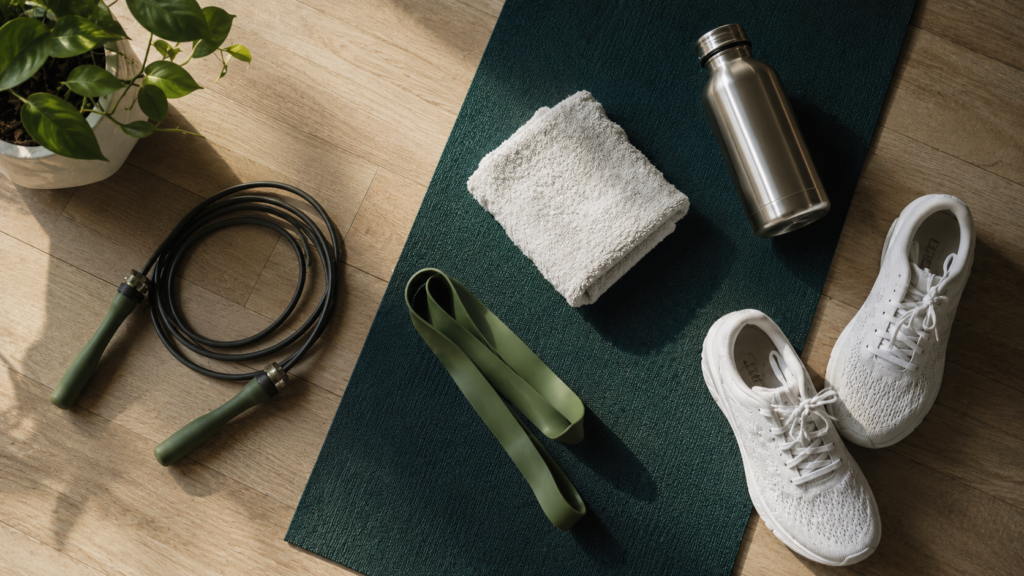
The bodyweight basics that actually work
For your first 8 to 12 weeks, almost any sensible program works. The names are boring because they’re old: push-ups, squats, lunges, planks, glute bridges, mountain climbers, jumping jacks, burpees. These movements have been used for over a century because they hit the muscles that matter. Add running or fast walking and you have a complete program.
I built my first routine around four bodyweight sessions a week (about 25 minutes each) plus three short runs (15 to 25 minutes each) on the beach. No equipment, no schedule, no app. The first month was harder than going to the gym had been. The first three months are when I lost the most weight.
Where outdoor space saves you the most
Living near the beach is what made my early months stick. There’s something about the sound of waves, the cool air at 6 a.m., and other people training around you that does what no app notification can do: it gives you a reason to show up that isn’t willpower. If you don’t have a beach, your version is a park, a school track, a quiet street, or even a stairwell in your own building. Find your version of an outdoor place that makes you want to be there. That’s your gym now.
For a complete beginner-friendly bodyweight program — exact exercises, sets, reps, and weekly progression — I broke that down in this home workout plan for beginners. Use it as your starting framework if you don’t want to design your own (more on why that’s a bad idea below).
Pillar 2 — Eating Well to Stay Fit on a Budget
Here’s the part where the budget side really shines, because the cheapest food is also often the best food for fitness. Brazilian staples — rice, beans, eggs, chicken thighs, seasonal vegetables, oats, bananas — make up the foundation of how I eat. None of those cost more than they did five years ago, and all of them are recommended by every dietitian I’ve ever read.
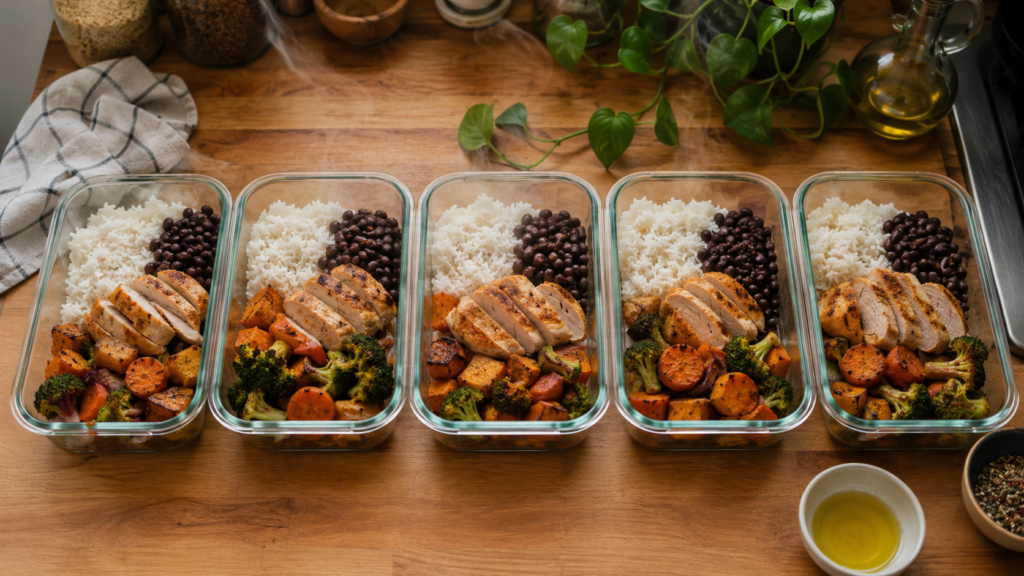
What my $100 a month actually looks like
Roughly: $25 on rice, beans, lentils, and oats; $30 on chicken thighs, eggs, and the occasional ground beef; $25 on vegetables and fruit; $15 on staples like olive oil, coffee, salt, and spices; $5 on whatever’s on sale. I shop once a week, almost always at the same neighborhood market.
Compare that with what the same person would spend on delivery and unplanned takeout: I tracked my spending in 2023 before I changed habits, and on weeks where I didn’t cook I averaged about $250 a month on food. Almost all of that was lower-quality calories. Switching to cooking at home cut my food cost by 60% and improved what I was eating, without needing to buy anything labeled “fit” or “healthy.”
Meal prep: the 2-3 hours that change everything
I spend about two to three hours every Sunday cooking in batches: a big pot of rice, one of beans, a tray of seasoned chicken in the oven, and chopped vegetables in containers. That covers Monday through Friday — usually 5 lunches and 5 dinners. Weekends I eat more freely, including meals out, and that flexibility is the reason the rest of the week stays on track. A diet you hate by Wednesday isn’t a diet — it’s a punishment.
For specific weekly grocery lists, cheap protein ideas, and a step-by-step meal-prep approach, see my full guide to eating healthy on a budget and the cheap meal prep guide for beginners. Together they cover the tactical side of nutrition that this guide can’t fit.
Pillar 3 — Recovery on a Budget: The Free Stuff Most Beginners Ignore
You can have the best workout routine and the cleanest diet on earth, and if you sleep five hours a night and never sit still, you’ll stall. Recovery is the boring pillar, and it’s also the one I almost skipped. None of it costs anything.
Sleep is the cheapest performance enhancer
According to the Centers for Disease Control and Prevention (CDC), adults need 7 or more hours of sleep per night. Most beginners I know are at 5 to 6, and they wonder why their workouts feel impossible. I’m not perfect at this, but I aim for 7 hours minimum, and the difference between a 5-hour night and a 7-hour night is enormous in how I train the next day.
Walking is underrated
Outside of structured workouts, walking is the highest-value habit you can add. It burns calories, improves cardiovascular health, helps you recover from harder workouts, and clears your head. I aim for one 20-30 minute walk a day, usually after dinner, often by the beach. I don’t track steps. I don’t care about hitting 10,000. I just walk because it makes everything else easier.
Stress and water
Drink water. Boring, free, and the difference between drinking enough and not is real. As for stress: training and sleeping well already help with this, but if your life is high-stress for non-fitness reasons, addressing that is more important than any workout. The body recovers from a missed gym session. It doesn’t recover from chronic stress without intervention.
Pillar 4 — Mindset and Consistency (The Pillar That Decides Everything)
Here’s the contrarian opinion I’ve developed after two years: it’s not steps, it’s not calories, and it’s not even the specific workout program that decides whether you transform your body. It’s organization, planning, dedication, and especially nutrition. Programs come and go. The ability to organize your week and make decisions ahead of time is what makes the program work at all.
I learned this the hard way. My first three months I tracked every calorie obsessively. Then I realized I was burning more energy worrying about the spreadsheet than about my workout. I dropped the tracking and replaced it with simpler systems: one shopping list, one meal-prep day, one weekly training schedule. My results actually improved. The brain has a finite amount of decision-making capacity in a day. The fewer decisions your fitness asks of you, the more reliably it gets done.
There’s also something about the visual environment that nobody talks about. Living near the beach and seeing other people training — light, happy, in normal clothes, no Instagram filters — has been one of the biggest motivators in my life. If you can find or build an environment that subtly nudges you toward your goals, it’s worth more than any motivational quote you’ll read on Reddit.
Equipment Tiers to Get Fit on a Budget — $0, $50, and $200
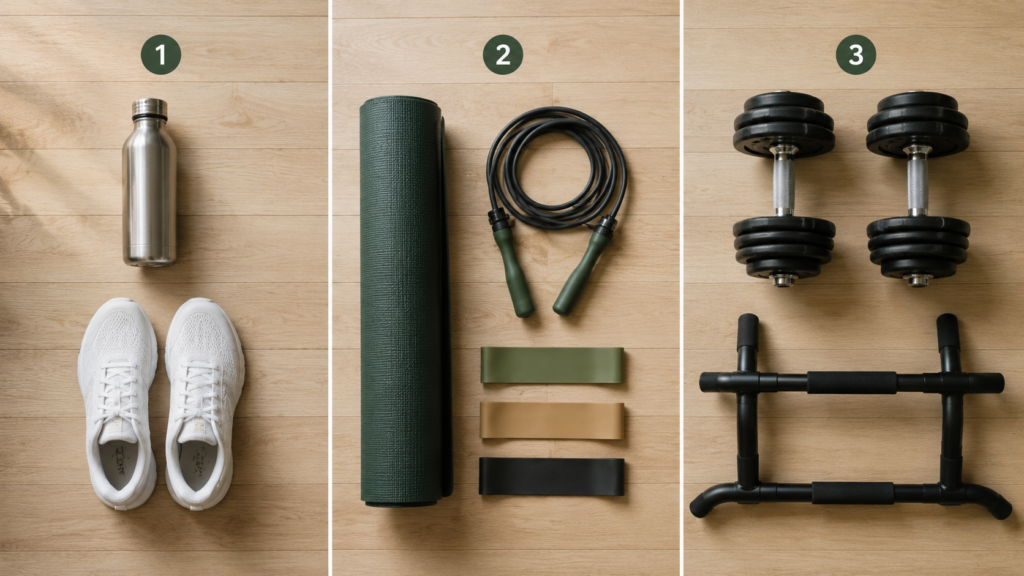
You don’t need to buy anything. But if you want to add a few pieces of gear as you progress, here’s how I’d allocate the budget if I were starting over today.
Tier 1: $0 — What I started with
- Your bodyweight (free)
- Floor space the size of a yoga mat (free)
- A pair of running shoes you already own (free, if you have any)
- A water bottle (free, you have one)
This was my entire setup for the first 4 months. It was enough to lose 12 of the 15 kg.
Tier 2: $50 — The minimal upgrade
- A decent Yoga mat ($15-25) — your knees will thank you on push-ups and planks
- A jump rope ($8-12) — best cardio you can do at home in a small space
- A set of resistance bands ($15-25) — adds variety and difficulty without weights
This is where I’d send a friend who’s asking. With $50 you remove every excuse and add 90% of the training options of a basic gym.
Tier 3: $200 — The “I’m staying with this” upgrade
- Adjustable dumbbells or a basic dumbbell set ($80-120)
- A pull-up bar that hangs in a doorframe ($25-40)
- A second pair of athletic shoes ($40-60) so they last longer
You don’t need to reach Tier 3 in your first year. I waited about 14 months before adding dumbbells. Buying gear before you have the consistency to use it is one of the classic mistakes — which leads us into the next section.
5 Money Mistakes I Made (So You Don’t Have To)
Mistake #1 — Buying every supplement I saw on Instagram
In my first three months I bought a tub of whey protein, a tub of mass gainer, a pre-workout, a fat burner, BCAAs, and a “shredding” stack I couldn’t even pronounce. Total damage: about $180. Total effect on my body: zero. I learned later that almost none of that mattered for someone at my training level. Real food beats supplements, and the gains people credit to powders are mostly the gains they’d have made from training and sleeping better. Don’t spend a single dollar on supplements until you’ve been training consistently for at least 6 months.
Mistake #2 — Quitting in month 1 because I didn’t see results
Most beginners give up between week 3 and week 5. I almost did the same thing. I stepped on the scale after 30 days expecting to be a different person and saw I had lost 1.5 kg. It felt like nothing. Six months later I had lost 15 kg. The lesson: month 1 is invisible, month 2 you start to feel different in your clothes, month 3 other people start to notice, and month 6 is when the photos look different. You can’t skip the invisible months.
Mistake #3 — Inventing my own training plans
I tried to “design my own workout” off YouTube videos and Reddit threads, mixing exercises that don’t belong together, increasing weight too fast, and skipping warm-ups. Result: minor lower-back strain around month 4 that took two weeks to fully resolve. Nothing dramatic, but enough to slow me down. Use a real beginner program written by a coach (free ones exist all over the web — Reddit’s r/Fitness wiki, Athlean-X’s beginner videos, Nerd Fitness). Save the creativity for year 2.
Mistake #4 — Comparing my month 2 to other people’s year 5
Instagram and TikTok will show you people who look incredible, and you’ll assume they got there in a few months on a “secret program.” They didn’t. Most of the people I follow now took 3 to 7 years to build the body they show online, and many of them have genetics that make my own progression look slow. Compare your month 6 to your month 1. That’s the only comparison that matters.
Mistake #5 — Treating “fitness” as separate from the rest of my life
I kept thinking of training and dieting as a “phase” I had to push through to reach a goal. The phase mentality is why people lose weight, hit a number, and then bounce back six months later. The shift that finally worked was thinking of fitness not as a project, but as a way of organizing the week. You shop on Saturday. You meal-prep on Sunday. You train on these specific days. It becomes as automatic as brushing your teeth, and you stop “trying.”
A Real Week of My Workouts and Meals
Here’s what a typical week looks like for me right now, two years in. Yours doesn’t have to look like this — but it gives you a concrete example to model from.
Monday
- Morning: 25 minutes bodyweight workout at home (push-ups, squats, plank, lunges, mountain climbers)
- Lunch: rice + beans + grilled chicken + salad (meal-prepped)
- Evening: 20-minute walk by the beach
Tuesday
- Morning: 25-30 minute beach run (slower pace)
- Lunch: same prep
- Evening: stretching, early sleep
Wednesday
- Morning: gym session — upper body weights (about 45 minutes)
- Lunch: same prep
- Evening: walk
Thursday
- Morning: rest or light beach walk
- Lunch: same prep
- Evening: bodyweight workout if I missed Monday
Friday
- Morning: gym session — lower body weights
- Lunch: same prep
- Evening: walk
Saturday
- Morning: long beach run (35-45 minutes) or hike
- Eat freely — meals out are normal here
Sunday
- 2-3 hours of meal prep for the upcoming week
- Grocery shopping
- Rest, family time, no training
That’s 4 to 5 training sessions a week, no rigid timing, all built around when I have natural energy. The point isn’t the specific schedule — it’s that everything has a fixed slot, so I never have to “decide” whether to train. The decision was made on Sunday.
How Long Until You See Real Results?
This is the question I get asked more than any other, so let me give you the honest version of the answer based on what I and dozens of people I know have actually experienced.
Week 1-2: You feel different, you don’t look different
You’ll notice you’re less tired in the afternoon, you sleep better, your mood is steadier. The scale might move 1-2 kg, mostly water weight. Don’t take photos yet.
Week 3-4: Clothes start fitting differently
A pair of jeans that was tight is now comfortable. Your shirts hang slightly different. The mirror doesn’t look dramatically different to you, but a friend who hasn’t seen you in a while will probably comment. This is when most people quit, ironically — right when it’s starting to work.
Month 2-3: Other people notice
You’ve lost real weight (or gained real muscle, depending on your goal). People you see weekly start making comments. Your training capacity is visibly improved — you can do more push-ups, run longer, lift heavier. This is the first highly motivating phase.
Month 4-6: The photo-ready phase
If you’ve been consistent, this is when before-and-after photos start to look real. I lost most of my 15 kg in this window. Strength has compounded. Routines feel automatic, not like willpower.
Month 7-12: The maintenance and refinement phase
You shift from losing/gaining quickly to building muscle, refining body composition, or maintaining. The pace of visible change slows, but your overall capacity keeps increasing. This is also when most people who didn’t build a sustainable system regress. If you’ve organized your habits well, you don’t.
Frequently Asked Questions
Can you really get fit without a gym?
Yes — for at least your first 6 to 12 months, easily. Bodyweight training plus running, walking, or cycling will produce 80% of the visible results most beginners are looking for. After that, weight training accelerates muscle gain, but you can still do that at home with a basic dumbbell set or resistance bands.
How much money do I really need to start?
$0. Literally nothing. If you have shoes, water, and floor space, you have everything required to start training today. I’d suggest budgeting maybe $30-50 for a mat and a jump rope after the first month, but it’s not necessary on day one.
Are supplements ever worth it?
For beginners — almost never. After 6+ months of consistent training, a basic whey protein can be convenient if you’re not hitting protein targets through food. Creatine monohydrate is the only supplement with strong evidence at any level. Everything else is mostly marketing. Save your money.
How often should I train as a complete beginner?
3 to 4 times per week, 20 to 30 minutes per session, is plenty for the first 2-3 months. Add a 4th or 5th session once you’re recovering well. Daily training as a beginner usually leads to burnout or minor injury within a month or two.
Do I need to count calories to lose weight?
You don’t need to, but it can help for the first 2-4 weeks just to learn what real portion sizes look like. After that, the system that worked for me is: cook at home most meals, eat plenty of protein and vegetables, eat normally on weekends, walk every day. I haven’t counted a calorie in over a year and my body composition has continued to improve.
What if I have only 15-20 minutes a day?
That’s plenty to start. Three rounds of 5 exercises (push-ups, squats, plank, lunges, mountain climbers) takes about 15 minutes and gives you a real workout. Consistency over six months matters far more than session length.
Your Next Step
You now have the framework. The next move depends on what you most want to fix first.
- If movement is your weakest point: open the ultimate home workout plan for beginners and pick a day this week to do it.
- If nutrition is what trips you up: read how to eat healthy on a budget and write your first grocery list this Sunday.
- If you can already do both but never have time: the cheap meal prep guide for beginners will save you the 5 to 8 hours a week most people lose to last-minute food decisions.
You don’t need a perfect plan. You need a started plan. Two years ago I was 100 kg and unhappy in photographs. Today I’m a different person, and the entire transformation cost me less than three months of that gym I quit. If I could do it from where I started, your version is also possible. Pick the smallest possible first action and do it today. Everything else builds from there.
— Gabriel Founder, Fit Budget Life
Pingback: The Ultimate Home Workout Plan for Beginners (No Equipment)
Pingback: How to Eat Healthy on a Budget (Beginner Guide)