
The Thursday That Made Me Build a Weekly Meal Plan
This article contains affiliate links. If you buy through these links, I may earn a small commission at no extra cost to you. I only recommend products I personally use and trust.
This is how I built a $50 weekly meal plan that actually works after two years of trial and error — 7 days, 21 meals, real food, real numbers.
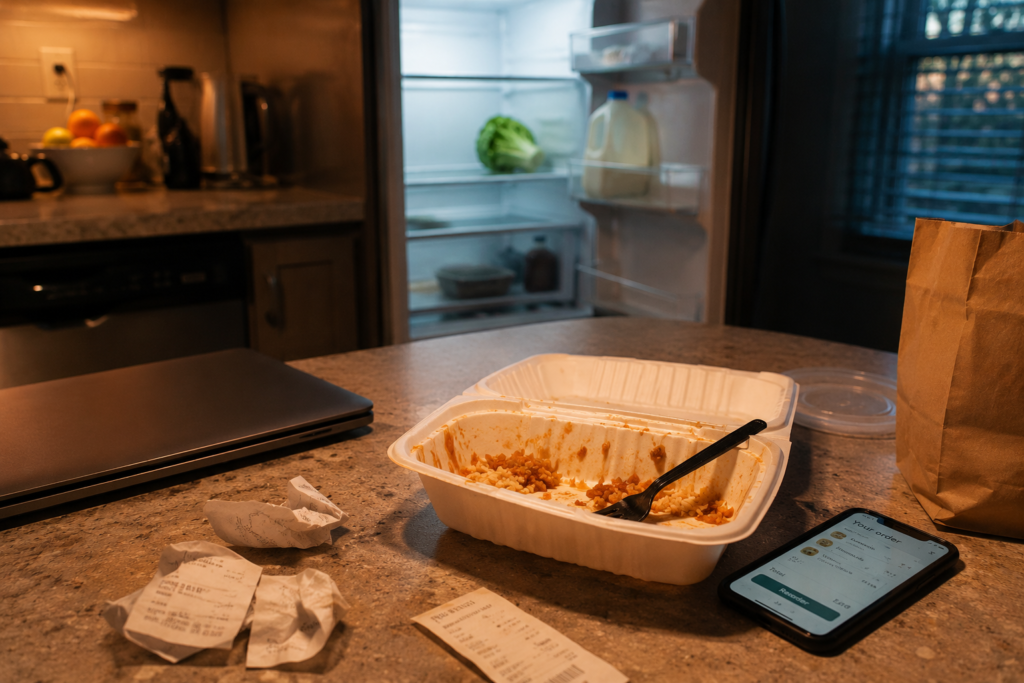
For years, my relationship with the kitchen was chaos. I’d open the fridge at 7pm with no idea what to make, improvise with whatever was left over, and by Thursday I was already ordering delivery with a vague guilt running in the background. I knew how to cook — I grew up watching my mother plan the week’s meals with a kind of natural ease I never quite understood. But knowing and doing are two different things.
I’d just started training again. Still in that phase where you arrive at the gym hyped and come home with zero energy, eating whatever’s in front of you. After three weeks of consistent training, I looked in the mirror and thought: why isn’t this showing?
The answer wasn’t the gym. The answer was the empty Sunday fridge and the Thursday delivery.
That’s when the meal plan came in. Not as a magic diet. Not as a strict regimen. Just the boring, necessary piece of the puzzle that had been missing.
Today, my partner and I split a $50 weekly meal plan — 7 days, 21 real meals per person, no delivery, no decisions at 7pm on a Tuesday. The system has been running for two years. This is exactly how it works.
Why Most Weekly Meal Plans Fail (And Why This One Doesn’t)
Most meal plan articles you’ll read are written by people selling you something — a cookbook, a course, an app, a service. The advice ends up looking like a recipe binder. Try 15 different lunches! Rotate 12 dinners! Variety is everything!
That advice is wrong, and it’s wrong because it ignores how human energy actually works on a Tuesday night.
After two years of trial and error, here’s what I learned:
Variety is overrated. Structure is everything.
The reason my old meal plans failed wasn’t that the recipes were bad. It was that I was trying to be a chef when what I needed was to be an operator. Five different lunches across the week meant five different shopping lists, five different cooking sequences, five different cleanup routines.
What works is the opposite: one structure, small variations.
A balanced template — protein + carb + legume + vegetables — that I execute slightly differently each week. Same architecture. Different details. The brain stays satisfied because the flavors rotate. The system stays alive because the structure doesn’t change.
For the broader philosophy behind the $50 budget that makes this possible, the prerequisite article is How to Build a $50 Weekly Grocery List — the grocery system this meal plan was built on top of.
My $50 Weekly Meal Plan: System Overview
Here’s the system in one paragraph:
Every Sunday morning, I cook 5 lunches, 5 dinners, and 5 protein snacks for the work week. Breakfast is the same daily template (eggs + bread). Weekends are looser — fresh cooking, eating out, deliberate flexibility.
That’s it.
Five lunches, five dinners, five snacks. Fifteen prepared containers, lined up by Sunday evening. Add the daily breakfast (5 minutes, made fresh) and weekend free-cooking, and you have 21 meals covered per person, per week — for around $50 between two adults.
The whole architecture rests on three principles:
- Cook once. Eat all week. Sunday is the only real cooking day.
- Decision-making happens once. I decide the menu Saturday, shop Sunday morning, cook Sunday afternoon. By Tuesday night, the only decision is “microwave 3 or 5 minutes.”
- Flexibility is built in. Weekends are deliberately unstructured. One indulgence per week, always.
Now let me show you the actual meals.
The Exact 7-Day Weekly Meal Plan (21 Meals)
Here’s what a typical week looks like in my kitchen. Note: the lunch/dinner template stays consistent, but the specific proteins, vegetables, and carbs rotate based on what was on sale at the market.
Daily Breakfast (5 min, made fresh every morning)
- 2-egg omelet + 1 slice whole grain bread + black coffee
That’s it. Same thing every weekday. Why? Because by 7am, I don’t want to think. The omelet gives me protein and satiation in 5 minutes flat, and the boredom of repetition is a feature — it removes decision fatigue and keeps breakfast cheap.
Snack Options (2 rotating per week)
- Option A: 170g Greek yogurt + small handful of granola + a drizzle of honey
- Option B: Crepioca (a Brazilian tapioca-and-egg pancake) stuffed with tuna, shredded chicken, or ground beef
I switch between these depending on whether I’m in a fast-protein mood (yogurt) or want something more substantial (crepioca).
Fruit Options (2 per week, seasonal rotation)
- Banana (pre/post workout, easy to carry)
- Apple (quick snack, no prep)
The 7-Day Lunch + Dinner Plan
| Day | Lunch | Dinner |
|---|---|---|
| Mon | Brown rice (4 tbsp) + black beans (1 ladle) + grilled chicken (150g) + leafy salad with tomato and shredded carrot | Sweet potato (150g) + canned tuna (120g) + cucumber salad with olive oil |
| Tue | Brown rice + lentils (1 ladle) + ground beef (150g) + sautéed zucchini | Whole-wheat pasta (80g dry) + homemade tomato sauce + shredded chicken (120g) + steamed broccoli |
| Wed | Brown rice + black beans + baked fish (150g) + collard greens + carrot | 3-egg vegetable omelet (tomato, spinach, onion) + 2 tbsp rice |
| Thu | Brown rice + lentils + grilled chicken (150g) + beet and arugula salad | Sweet potato (150g) + ground beef (120g) + green salad |
| Fri | Brown rice + black beans + grilled fish (150g) + colorful salad with corn and tomato | Whole-wheat pasta (80g) + tomato sauce + shredded chicken (120g) + broccoli OR free-meal night |
| Sat | Free meal — usually breakfast at home, eat out for lunch or dinner | Free meal |
| Sun | Cook day. Fresh meal made from prep ingredients. | Cook day. Light dinner. |
That’s it. Twenty-one meal slots, filled. No surprise emergencies. No 7pm decisions. No “we have nothing in the fridge.”
The portion sizes work because I weigh them. A basic digital kitchen scale (~$12) is the cheapest investment that pays for itself in saved food and accurate macros. Mine lives on the counter and gets used every Sunday.
My Sunday in the Kitchen: A 3-Hour Choreography
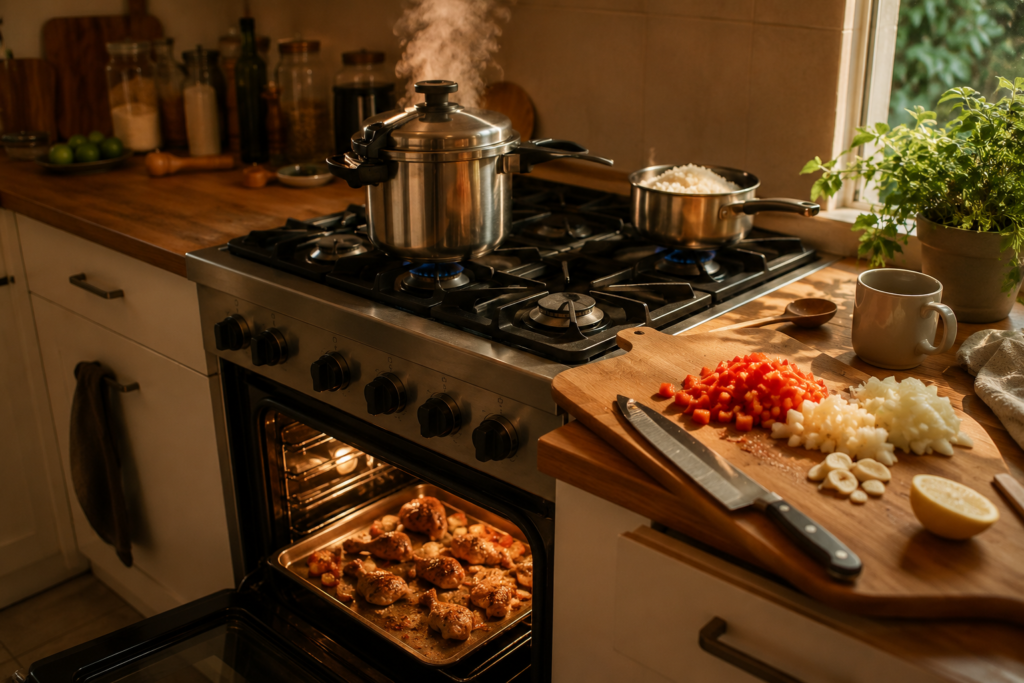
The reason this system works isn’t the menu. It’s the process. Three hours on a Sunday that look chaotic from the outside, but follow a tight choreography on the inside.
9:00 — The market
I leave the house with a list on my phone and arrive at the market before 10am. Going early matters: less crowded, fresher produce, and my mind isn’t tired yet. I walk the aisles without rushing, compare prices, choose deliberately. It’s almost meditative — as long as I don’t shop hungry.
Thirty minutes in and out. Lists kill hesitation.
10:30 — The slow stuff goes first
Back home. Music goes on (something with a Sunday-afternoon energy — not too hyped, not too sleepy). And I start what I’ve come to think of as “the longest things first” principle.
The moment I’m in the kitchen, three things start running in parallel:
- Beans in the pressure cooker (25 minutes from cold start instead of the 90 minutes a regular pot needs)
- Chicken seasoned and into the oven (35 minutes)
- A tray of vegetables in the air fryer for the week (18 minutes)
While those run, I have a 30-40 minute window of hands-off time. That’s the gold. That’s when the fast stuff happens.
10:45 — Parallel work
- Cook the rice (12-15 minutes)
- Wash and chop salad ingredients for the week
- Boil eggs for snack containers
- Wash the fruit I’ll be eating between meals
- Prep the tomato sauce for the pasta days
- Wipe down the counter as I go, so cleanup at the end is minimal
The goal is for everything to finish within a 10-minute window. That way, I’m portioning hot food straight from cooking into containers — not refrigerating warm leftovers, not letting things sit and lose texture.
12:30 — Portioning
When the chicken comes out of the oven, the beans are off the pressure cooker, the rice is done, and the vegetables are roasted, everything goes into containers in the same balanced template.
5 lunches + 5 dinners + 5 snacks = 15 containers, sealed, labeled with the day if needed.
13:30 — Done
Cleanup. Music off. Coffee. The kitchen is clean. The week is, in a real sense, already finished. I haven’t lived it yet, but I’ve removed every food decision from it.
That feeling — looking at a fridge full of glass containers on a Sunday afternoon — is what keeps me doing this every single week.
The Infrastructure (Containers + Tools)
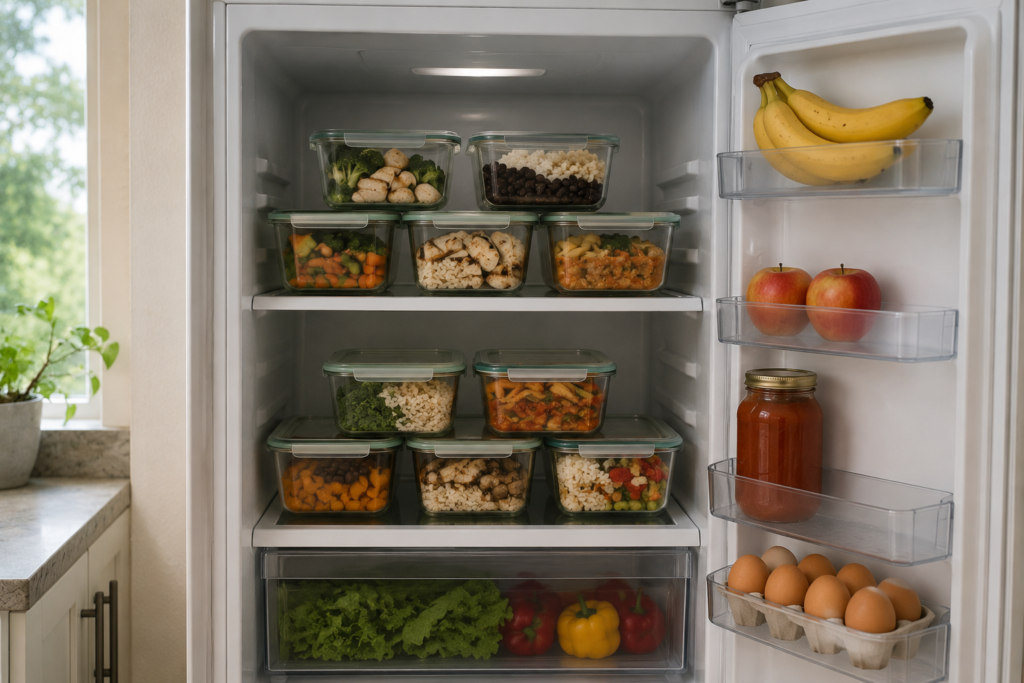
Here’s the surprising thing about cheap meal prep: the upfront infrastructure costs almost nothing compared to what you save in the first month.
My setup, in full:
Containers
I use 20 glass containers with snap-lock plastic lids. 10 for lunches (couple, both of us), 10 for dinners. I bought the glass containers as a set on sale two years ago and they’ve outlasted every plastic container I’d cycled through in the previous five years combined.
Why glass over plastic:
- Doesn’t stain, doesn’t absorb smells
- Goes from freezer to oven without thinking
- Microwave-safe forever
- After two years, they look identical to day one
Cooking equipment
The tools I genuinely use weekly:
- Pressure cooker — beans in 25 minutes, lentils in 15. The single most useful kitchen tool I own.
- Standard oven — chicken, fish, vegetables. The workhorse.
- Air fryer — vegetables in 18 minutes, reheating without sogginess.
- Frying pan — eggs, fast proteins, sauces.
- Two regular pots — rice, soup, pasta.
- Microwave — Tuesday-Friday: reheats in 3-5 minutes.
That’s the entire kit. No spiralizers. No specialty bakeware. No $200 stand mixers. The basics, used well, do everything.
If you want a deeper dive into the meal-prep system that built this routine, Cheap Meal Prep for Beginners covers the four tools and the timing in detail.
The Biggest Mistake I Made (So You Don’t Have To)
In the first months, I walked into the market on Sunday with a list of five different recipes. Five different proteins, five different cooking methods, five separate spice profiles. I’d be at the stove for four hours by the time it was done.
It looked ambitious. It was actually a disaster.
What happened, every single week:
- Too many pots, not enough hands. Things burned while I was attending to something else.
- Ingredients went unused because I’d planned for five recipes but only finished three.
- The variety I was chasing turned into food waste.
- The energy I started Sunday with was gone by the third recipe.
After about four weeks of this, I gave up the ambition and replaced it with the structure: one cooking method per pot, one carb, one or two proteins, vegetables in batches. Same ingredients, different combinations.
The frustrating truth I had to swallow: variety isn’t the goal. Consistency is the goal. Variety is the dressing on consistency, not the foundation.
If you take one thing from this article: don’t try to cook five different dishes on your first Sunday. Cook one big batch of three things. Add one variation in week two. Add another in week three.
Seasonal Adjustments (Summer vs. Winter)
The meal plan above is roughly what I eat year-round. But two things shift with the seasons:
In winter: more soups, more roasted root vegetables, more hearty stews. The Tuesday pasta gets swapped for a lentil soup. The salads get smaller. The portion of carbs gets slightly bigger.
In summer: more salads, more grilled proteins instead of roasted, lighter dinners. Fruit takes a bigger role — berries replace the apples, watermelon enters the rotation.
The structure (protein + carb + legume + vegetable) doesn’t change. The specific items rotate based on what’s seasonal, what’s fresh, and what’s cheap that week.
Social Events: How I Don’t Break the System
Here’s the question I get most: “What about when friends invite you to dinner? What about weekends?”
My honest answer: social events are essential, not optional.
Eating out with friends, going to a Sunday barbecue, attending a birthday dinner — these aren’t violations of the system. They’re the reason the system can survive long-term. A meal plan that doesn’t allow for the social part of food is a meal plan that breaks in week four.
What I do:
- Friday dinner is sometimes a free meal. If we have plans, I plan around it.
- Saturdays are entirely flexible. We eat out, cook fresh, order delivery once a month if we feel like it.
- One indulgence per week is always built into the plan. For me, it’s something sweet — usually a small portion of dark chocolate or a “fitness dessert” (a protein-based treat that fits the budget and the goals).
The rule isn’t perfection. The rule is: 5-6 days a week, you eat the prep. 1-2 days, you eat freely. That ratio is what makes it sustainable across years instead of weeks.
The Time Math: 6 Hours Back Per Week
People assume meal prep adds time to your week. The opposite is true.
Before the system, my week looked like this:
- 30 minutes most weeknights deciding what to cook
- 45 minutes cooking from scratch most weeknights
- 2-3 trips to the market per week, 30 minutes each
- 1-2 delivery orders per week when I was too tired
- The mental load of “what do I eat?” running quietly all day
Now:
- 3 hours on Sunday, total
- 5 minutes of reheating per weeknight meal
- 1 market trip per week (Sunday morning, 30 minutes)
- 0 deliveries on average
- Zero food-decision noise during the week
The math: roughly 6 hours saved per week. That’s 24 hours per month. That’s a full extra day of life given back to me — and used for things that matter more than choosing between rice and pasta on a Tuesday at 8pm.
If you’re combining better nutrition with rebuilding your overall fitness, How to Eat Healthy on a Budget covers the wider food framework, and The Ultimate Home Workout Plan for Beginners handles the training side. Together they’re the two pillars of a budget-friendly body transformation.
How to Start Your Weekly Meal Plan This Sunday
If you read this far, here’s the exact starter plan:
- Saturday: Write your menu for the week. Don’t try to be ambitious. Pick one protein, one carb, one legume, and seasonal vegetables. Note quantities.
- Sunday morning, 9am: Go to the market with the list. Stick to it. Take 30 minutes.
- Sunday morning, 10:30am: Beans in the pressure cooker (or canned beans if you don’t have one yet). Chicken in the oven. Vegetables in the air fryer or a second oven tray.
- Sunday morning, 10:45am: Music on. Cook the rice. Chop the salad ingredients. Boil 4-6 eggs for snacks. Wash fruit.
- Sunday noon: Portion everything into containers. 5 lunches + 5 dinners + 5 snacks.
- Sunday afternoon: You’re done. Clean up. Coffee.
That’s the whole system. The first Sunday will feel awkward. By the third Sunday, it’ll feel automatic.
FAQ
“$50 a week for two people. Is that really realistic?”
Yes — for two adults in a country with reasonable grocery prices. We’ve been doing it for two years. The math works because rice, beans, eggs, and seasonal vegetables are genuinely cheap when bought without name-brand attachment. If you live somewhere groceries are dramatically more expensive (some major US cities), scale to $70-80/week for two using the same logic.
“What if I can’t cook?”
You don’t need to know how to cook to do this. If you can boil rice, season chicken, and turn on an oven, you can do every meal in this plan. Nothing in the rotation is more complicated than that.
“How long does the food really last in the fridge?”
Cooked rice, beans, and roasted vegetables last 4-5 days refrigerated in airtight containers. Egg-based meals last 3-4 days. The trick I use: containers for Monday-Tuesday stay in the fridge from Sunday, but Wednesday-Friday’s containers go into the freezer on Sunday and move to the fridge on Tuesday night. By Thursday, the food tastes like it was cooked the day before.
“Won’t I get bored eating the same meals?”
Honestly? Less than I expected. The variety happens at the seasoning level, not the ingredient level. Same chicken, four different spice profiles across the month. Same rice, different sauces. The boredom is mental — once your brain accepts that “exciting” isn’t the goal of weekday meals, the issue dissolves.
“What if my partner doesn’t want to do this?”
Start with yourself. Cook your own 5 lunches + 5 dinners on Sunday. Let your partner observe the system for a few weeks. The visible benefit — full fridge, no Thursday stress, more shared time on weekday evenings — usually converts people without an argument.
“Can I scale this to a family with kids?”
Yes. The system scales linearly. A family of four uses the same Sunday structure with bigger batches. Add a Wednesday mini-prep (20 minutes, fresh salads and a sauce) and you cover everyone without burnout.
The Bigger Picture
A $50 weekly meal plan isn’t about eating cheaply. It’s about removing decisions from the worst moments of your week — hungry, tired, rushed — and putting them into the best moment of your week: a calm Sunday with music and coffee.
It’s about realizing that the time you think meal prep “costs” is actually time you were already losing — invisibly, daily, spread across your week in tiny decisions and delivery orders and last-minute market runs.
Three hours on a Sunday gives you back six hours during the week.
That’s not deprivation. That’s leverage.
Want More Like This?
If this article helped, you’ll like:
- How to Build a $50 Weekly Grocery List — the grocery system this meal plan was built on
- How to Eat Healthy on a Budget: A Simple Beginner Guide — the broader food philosophy
- Cheap Meal Prep for Beginners (Save Time and Money) — the four tools and the timing in detail
- How to Get Fit on a Budget (Without a Gym) — the broader budget-fitness framework
📬 Get one honest fitness/budget lesson every Sunday → Subscribe to the Fit Budget Letter in the form below. No spam, unsubscribe anytime.
External resources for further reading:
- USDA MyPlate — official US government framework for balanced meal planning
- Bureau of Labor Statistics: Food Expenditure Series — average household food spending data
- Harvard T.H. Chan School of Public Health: Healthy Eating Plate — evidence-based nutrition framework