
This article contains affiliate links. If you buy throughthese links, I may earn a small commission at no extra costto you. I only recommend products I personally use and trust.
The Saturday I Opened My Fridge and Couldn’t Eat
This is how I built a $50 weekly grocery list that actually feeds me real food — without supplements, without 6 AM Walmart runs, and without throwing 30% of it in the trash by Wednesday.
It was a Saturday morning. I walked into the kitchen with one mission: grab a piece of fruit before my workout.
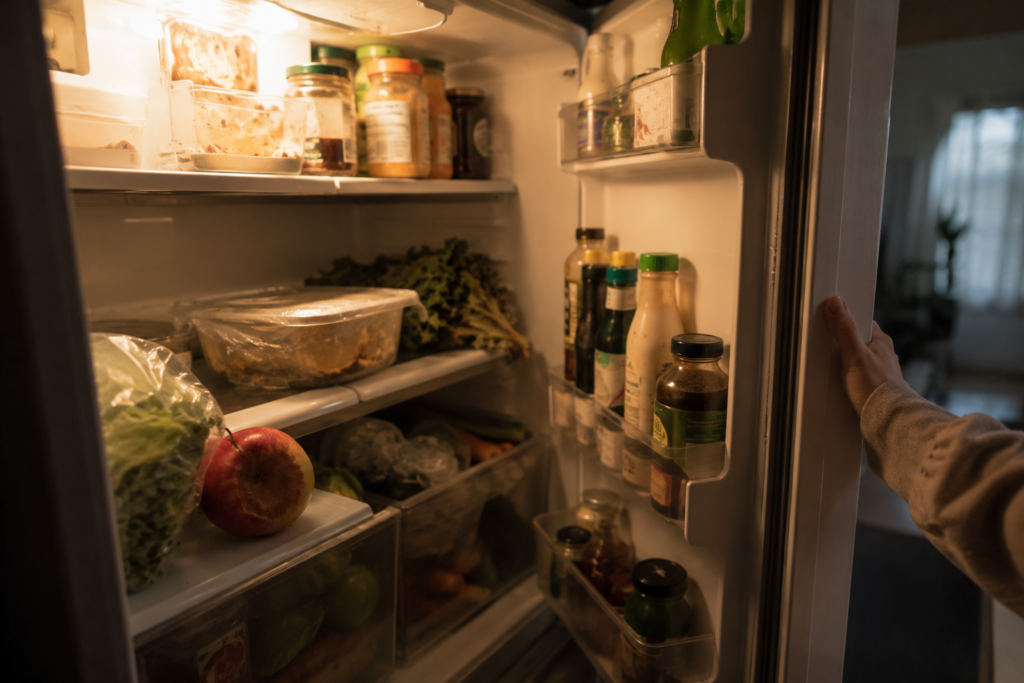
I opened the fridge. The apple I’d planned to eat? Mushy. Half a bag of greens? Slimy. A container of leftovers from “I think Wednesday”? I didn’t even want to open it.
I closed the fridge, walked back to the couch, and ordered breakfast. Diet broken. Routine broken. Eighteen dollars spent on delivery, plus the receipt of all the food I was about to throw away.
That was the moment I realized: I wasn’t just losing money to bad groceries. I was losing my routine, my diet, my momentum. The thing I’d bought to be healthier was actively making me less healthy.
At the time, I was spending around $165 a month on groceries (I live in Portugal — that’s about €150). I’d do one big monthly run and try to make it last. The math sounded smart. The reality was that I was throwing 30-40% of it in the trash by week three.
So I rebuilt the system from zero. Today, my partner and I spend about $50 a week on groceries, plus a small monthly run for non-perishables. We waste almost nothing, we eat better than we used to, and — somehow — we have more disposable income than back when I was wasting half my fridge.
This is exactly how we do it. Item by item, dollar by dollar, week by week.
How a $50 Weekly Grocery List Replaced My $165 Monthly Food Spending Strategy
Quick reality check on the title number, because I don’t want to lie to you:
- Before: ~$165/month, one massive monthly run, 30-40% thrown away = ~$110 of actual food eaten per month
- Now: ~$50/week × 4.3 weeks = ~$215/month, near-zero waste = ~$210 of actual food eaten per month
Yes, I technically spend slightly more per month now. But I’m eating almost double the food.
I never run out mid-week. I never throw expensive proteins in the trash. I never break my diet because “there’s nothing to eat.”
Translation: I went from spending money to throw food away → to spending money to actually eat well.
For me, that’s the only math that matters.
If you want the broader philosophy behind why budget fitness even works, I wrote How to Get Fit on a Budget (Without a Gym) — the cornerstone article of this blog, and the one that explains why food and fitness can’t be separated.
The 3 Mistakes That Made My Old System Fail
Before I rebuilt my groceries, I made the same three mistakes most people make. If any of these sound like you, you’re not alone — and you can fix them this week.
Mistake #1: One Huge Monthly Shop Instead of Weekly Trips
I thought I was being efficient. “I’ll just go once a month and stock up.”
The math sounded good. The reality was disaster.
Perishables — greens, fruits, dairy, fresh proteins — don’t survive four weeks. The first week I ate fresh; weeks three and four I ate canned beans and crackers because everything else had gone bad.
I’d also forget what I had. The next month, I’d buy duplicates of stuff still in the back of the freezer. Duplicates that I’d eventually throw out too.
The fix: I now split groceries into two missions — a monthly run for non-perishables, and a weekly run for fresh stuff. More on this below.
Mistake #2: Stocking Up on “Comfort Items” I Never Finished
My old pantry was a museum of half-used jars. Mayonnaise I bought for ONE sandwich, expired six months later. Sauces I bought “in case I cook fancy” that never got opened. Cookies and snacks I bought in family-size packs because they felt cheaper per gram — ate two, forgot the rest, found them stale a month later.
I was buying for the person I imagined I would be, not the person I actually was.
The fix: I now buy exactly one indulgence per week (a small treat for Saturday). That’s it. If I want more next week, I buy more next week. The buying horizon is seven days, not “what if.”
Mistake #3: No List, No Plan, No Boundary
I walked into the store hungry, with no list. I made decisions based on whatever looked good in the moment.
Every. Single. Time.
The result: $40-50 grocery trips that should have been $20. Random snacks. Premium proteins I didn’t need. A bottle of olive oil I forgot I already had at home.
The fix: Pre-written list. Debit card with exactly the budget + a small buffer. Never enter hungry. Detailed system below.
If you want a deeper breakdown of cheap, healthy meals overall, I wrote How to Eat Healthy on a Budget: A Simple Beginner Guide — it covers what these groceries become at the stove.
My Current System: Monthly Anchor + Weekly Refresh
The system that actually works has two grocery missions with very different roles.
1. The Monthly Anchor (First Monday of Every Month)
What we buy: non-perishables only.
- Rice
- Dried beans + canned beans
- Pasta
- Canned tuna
- Oats
- Olive oil
- Chickpeas
- Spices (salt, black pepper, paprika, garlic powder)
- Canned tomatoes
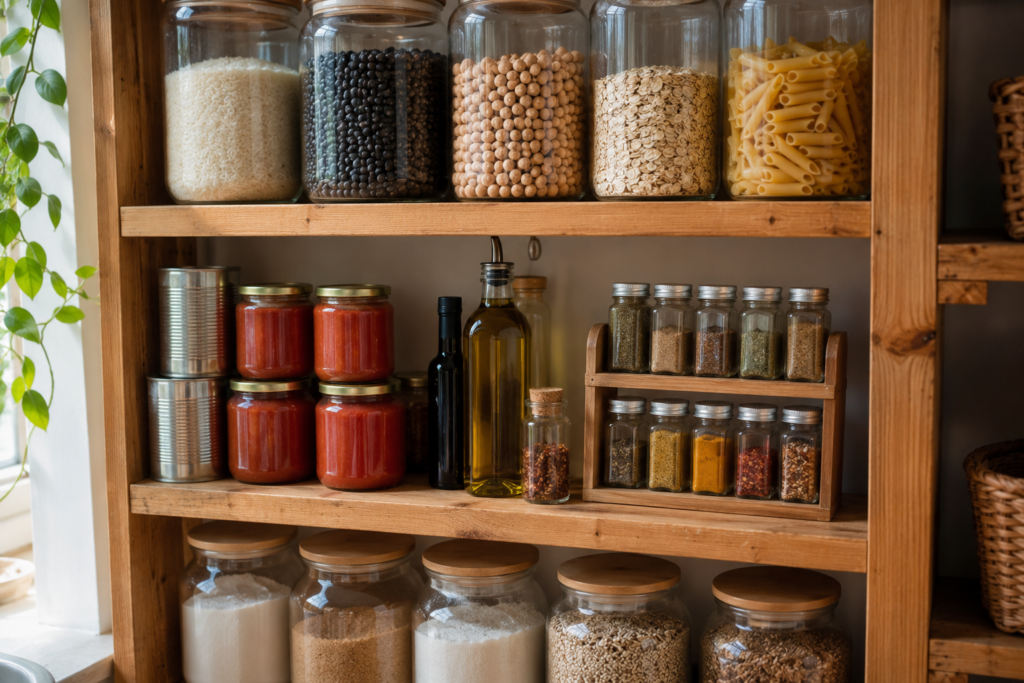
Time: about 1 hour 30 minutes, because we’re shopping volume.
Why this works: non-perishables don’t spoil. We buy the foundation of every meal for the entire month, in one trip, at the lowest unit prices.
Pro tip: if any of these are on deep promotion the week before, I’ll buy a double batch for next month. Locks in savings without risking waste — these items don’t expire. (Bonus tip: store them in airtight pantry containers once you open the bags. I switched after finding weevils in an open rice bag once. Never again. ~$30 for a set of 6, lasts forever, and you actually SEE what you have.)
2. The Weekly Refresh (Every Sunday Morning)
What we buy: anything that goes bad.
- 1 dozen eggs
- 1 lb of chicken breast (we rotate the protein each week — sometimes fish, sometimes ground turkey, sometimes pork)
- 3 types of fruit (seasonal — apples and oranges in cold months, berries and stone fruits in summer)
- Vegetables: broccoli, carrots, potatoes, beets, whatever looks fresh and is in season
- Leafy greens
- 1 weekly indulgence
Time: 25 minutes when we go together, 40 minutes alone.
Why Sunday morning: because then we have the entire day to plan, prep, and actually start using the food. The store is quiet at 9 AM Sunday. And mentally, it sets up the week — we know exactly what’s in the fridge and what we’re cooking on Monday night.
One small habit that compounds: I bring my own reusable produce bags to every trip. About $15 for a set of 9 cotton-mesh bags — the mesh actually keeps vegetables fresher in the fridge than plastic, and after a year of use they’ve already paid for themselves in plastic-bag fees. Looks intentional at checkout, too.
The Sunday morning grocery run pairs perfectly with The Ultimate Home Workout Plan for Beginners (No Equipment Needed) — Sunday is also the day I prep my training week.
My Actual $50 Weekly Grocery List (Item by Item)
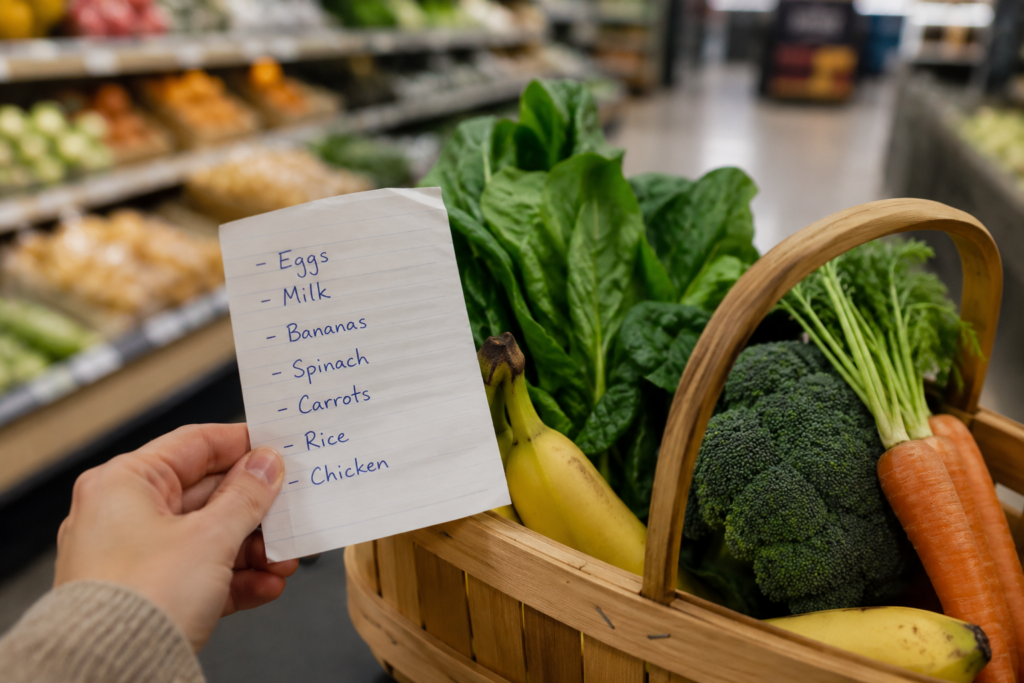
Here’s the real list. Real items, US-equivalent prices (yours will vary by region):
| Item | Quantity | Approx. cost |
|---|---|---|
| Eggs | 1 dozen | $4 |
| Chicken breast | 1 lb | $6 |
| Apples | 4 | $4 |
| Bananas | 6 | $2 |
| Berries (seasonal) | 1 pint | $4 |
| Broccoli | 1 head | $3 |
| Carrots | 1 lb bag | $2 |
| Potatoes | 3 lbs | $4 |
| Beets (or any root veg) | 1 lb | $3 |
| Greens (spinach or lettuce) | 1 bag | $3 |
| Plain yogurt | 32 oz | $4 |
| Whole grain bread | 1 loaf | $4 |
| 1 weekly indulgence | — | $3-5 |
| Buffer for promotions | — | $4 |
| TOTAL | — | ~$50 |
Combined with the monthly anchor (rice, beans, oats, oil, canned tuna, etc.), this feeds the two of us about 18-21 real meals per week. Breakfasts are mostly oats + fruit or eggs + bread. Lunches and dinners rotate between rice-bean-protein-veggie combinations, with the indulgence reserved for Saturday night.
A Note on Brands
I don’t have brand loyalty. I have price loyalty.
Here’s what I’ve learned in two years: for about 80% of grocery items, the store brand has nearly identical quality to the name brand, at 40-60% lower price.
- Rice? Store brand.
- Canned beans? Store brand.
- Yogurt? Store brand.
- Eggs? Store brand.
- Olive oil? Mid-tier name brand (one of the few exceptions where I taste the difference).
The grocery industry trains you to recognize logos. You don’t actually need to. Once you taste-test side by side, you’ll cut your grocery bill by 15-20% in a single week — and not notice the difference at the table.
The 4 Rules That Make $50/Week Real
These are the non-negotiables. Break any of them and the budget breaks too.
Rule 1: Pre-Written List With Exact Quantities. Always.
Before I leave the house, the list exists. Written on paper, in my Notes app, or photographed off the fridge whiteboard — doesn’t matter. What matters is that the decisions are already made.
Inside the store, my job is to find items, not decide between them. Decision-making in a supermarket is expensive — that’s literally what the entire store is designed to manipulate.
Rule 2: Debit Card. Exact Budget + Small Buffer.
I never bring a credit card. If I run out of money, the trip ends.
I carry the exact weekly budget (~$50) plus a buffer of about $30 for two situations:
- Something I planned for is unexpectedly more expensive
- A non-perishable I’d buy next month is unexpectedly on deep discount
That’s it. No “oh, just this one extra thing.” The boundary is mathematical, not emotional.
Rule 3: Buy Promotions ONLY for Items I Was Already Going to Buy
Supermarket promotions are engineered to make you buy more, not save more.
My rule: a promotion is only a deal if I would have bought the item at full price.
- Chicken on sale? Yes, buy. Already on the list.
- Frozen pizza on sale? No. Wasn’t buying that anyway.
- Olive oil on sale? Buy double — I’ll use it next month for sure.
If a non-perishable I genuinely use is on deep promotion, I’ll buy a “double batch” for next month. But never something I wasn’t going to buy at full price.
Rule 4: One Indulgence Per Week. No Exceptions.
This is the rule that keeps the whole system sustainable.
I’m not a robot. I want chocolate on Saturday night. Pretending I don’t want it is exactly how diets fail in week three.
So every Sunday, I buy one small indulgence. Not a family pack. Not “for the week.” One. Specific. Thing.
It gets eaten on Saturday. Then the indulgence loop resets. If I want more, I buy more next week.
This same “structure plus flexibility” thinking is the backbone of Cheap Meal Prep for Beginners (Save Time and Money) — the post that turned my groceries into actual weekly meals.
What I Wish Someone Had Told Me About a $50 Weekly Grocery List in Week 1
Three lessons that took me 3-4 weeks to figure out the hard way. You can have them now.
1. You Will Over-Buy at First. That’s Normal. Adjust in Week 2.
The first week I shopped this way, I bought based on what I thought I’d eat. I overshot vegetables (they went bad by Wednesday) and undershot proteins (ran out by Friday).
Don’t beat yourself up. It’s a calibration phase, not a failure.
Adjust week two. Adjust week three. By week four, you’ll know your real quantities — and they’ll be specific to YOUR life, not anyone else’s.
2. Do One Taste Test. It Will Save You Hundreds.
For each product type you buy, do this once:
- Buy the store brand AND the name brand
- Eat both in the same meal, side by side
- Honestly answer: can you tell the difference?
For me, the answer was “no” in 80% of cases. That single afternoon experiment cut my grocery bill by about 15%.
The few exceptions in my house: olive oil, coffee, and good chocolate. Everything else is store brand.
3. The Grocery List Is a Living Document. Update It Every Week.
Every Sunday, I tweak the list based on:
- What we didn’t finish last week (buy less next time)
- What’s in season (cheaper and fresher)
- What’s on this week’s promotion flyer
After about three months, your list becomes basically perfect for your taste and your store. Each week is a small experiment, and the experiments compound.
How This Actually Made My Life Better (Not Just My Budget)
I want to be honest about something. When I started this system, I was doing it for the money.
What surprised me was that the money turned out to be the smallest reward.
What I actually got:
- Peace of mind. I never panic at the end of the month wondering where my paycheck went.
- Money to invest. The ~$50-70 I save per month goes straight to my investment account. Small in isolation, but compounding.
- Guilt-free leisure. I know exactly how much I can spend on a dinner out, because the rest of the month is already planned and paid for.
- A diet that doesn’t break. When I open the fridge now, I see food I want to eat. So I eat it.
- Family that’s proud. My partner and family see the change, support it, and reinforce the habit socially. That kind of social fuel keeps things alive long-term.

Before this system, I’d look at my bank balance at the end of the month and feel a small flash of sadness. Honestly. Sadness.
Now I look at it and feel in control. That feeling is worth way more than the $50/week.
How to Start Your $50 Weekly Grocery List This Sunday
If you’ve read this far, here’s the exact plan to start this week:
This Sunday:
- Open your bank app and look at your grocery spending this month. Be honest. Don’t judge it — just see it.
- Decide your weekly number. Start with $60 if $50 feels tight — you’ll adjust later.
- Write the list using the template above. Adapt the items to what you actually eat.
- Go to the store with debit card + $30 buffer. Skip the credit card on purpose.
- Buy the list. Walk out. No “extras.”
Next Sunday:
- Look at what you didn’t finish from last week. Adjust the list down for those items.
- Repeat.
Week 4: you’ll have your own version of this system — dialed in to your taste, your region, and your actual life.
FAQ
“$50/week feels low. Can it really feed me?”
For one person, yes — combined with the monthly anchor (rice, beans, oats, oil). For two people, scale to $80-90/week using the same logic. The system stays the same; the numbers stretch.
“What if I don’t cook?”
This system assumes you’ll cook 4-5 simple meals a week (most are 20-minute meals). If you don’t cook at all yet, start with the four kitchen tools that make it stupidly easy: Cheap Meal Prep for Beginners (Save Time and Money).
“What if vegetables go bad before I eat them?”
Buy less next week. Seriously — that’s it. The list is a living document. After three weeks you’ll nail your real quantities. If you want a hack: freeze half of your weekly fresh produce on Sunday and thaw it Wednesday night for a “second fresh week.”
“What if my store doesn’t have store brands?”
Find the cheapest comparable name brand and apply the same logic. Or shop at Aldi, Lidl, or Walmart — they’re built around store-brand quality at supermarket-killer prices.
“How do I budget for special occasions?”
The $30 monthly buffer handles small surprises. For bigger events (birthdays, holidays, dinner parties), add a dedicated “occasions” line item to that month — don’t blend it into groceries, or the grocery system will break.
“Is this the same in the US as Europe?”
The system is identical. The exact dollar amounts and store names change, but the four rules (list, debit card, real promotions only, one indulgence) work anywhere in the world. I run this in Portugal. American readers tell me they run it in Texas, Oregon, and Vermont with the same results.
Why the $50 Weekly Grocery List Is Just the Start
A $50 grocery list isn’t about deprivation. It’s about deciding in advance what you actually want — and removing the noise of in-store impulse.
It’s also one piece of a bigger system. Fit body + healthy eating + financial control — they reinforce each other:
- If you cut grocery waste, you have more money for fitness.
- If you don’t have a gym (like me), the money goes to investments.
- If you invest more, you stress less about money.
- If you stress less, you eat better.
- If you eat better, you don’t need expensive supplements.
- If you don’t buy supplements, you have even more money for groceries that actually work.
It’s a loop. Each piece reinforces the next.
Pick one piece. Start there. The rest follows.
This Sunday, the grocery list is yours.
Want More Like This?
If this article helped, you’ll like:
- How to Get Fit on a Budget (Without a Gym) — the cornerstone of the entire approach
- How to Eat Healthy on a Budget: A Simple Beginner Guide — what to actually cook with these $50 of groceries
- Cheap Meal Prep for Beginners (Save Time and Money) — turning the groceries into a full week of meals
- The Ultimate Home Workout Plan for Beginners (No Equipment Needed) — what I do with the money I save on supplements and gyms
📬 Get one honest fitness/budget lesson every Sunday → Subscribe to the Fit Budget Letter in the form below. No spam, unsubscribe anytime.
External resources for further reading:
- USDA Thrifty Food Plan — official US government guidelines for low-cost grocery budgeting
- Bureau of Labor Statistics: Consumer Expenditure Survey — average household grocery spending by region and demographic in the US
- Harvard T.H. Chan School of Public Health: Healthy Eating Plate — evidence-based nutrition framework that pairs well with this kind of budget eating