
This article contains affiliate links. If you buy throughthese links, I may earn a small commission at no extra costto you. I only recommend products I personally use and trust.
Most beginners think they need an hour at the gym to get fit. They don’t. The single most underrated workout length for someone starting from zero is 15 minute — done consistently, three to five times a week, with zero equipment.
I know because that’s how I trained for the first several months of my fitness journey. Some days I had 60 minutes. Most days I had 15. The 60-minute sessions felt productive. The 15-minute sessions felt almost pointless. But here’s what I didn’t realize back then: it wasn’t the 60-minute sessions that built the habit — it was the 15-minute ones. The short workouts were the ones I never skipped, even on the worst days. And consistency beats intensity every single time.
This guide is the exact 15-minute home workout I’d hand to any beginner with no equipment, limited time, and a willingness to show up imperfectly. No fluff. No “fitness is a journey” clichés. Just what works when you actually only have a quarter of an hour.
All you’ll need: 15 minutes, some floor space, and ideally a decent yoga mat. Your knees and elbows won’t survive 15 minutes of push-ups on hardwood — trust me on this one. Everything else is your own bodyweight.
Why 15 Minutes Is Enough (When You’re Starting Out)
The fitness industry sells you the idea that you need 60-90 minutes per session to make progress. That works against beginners on two fronts: first, most people don’t have 60 minutes consistently, and second, your body in week one doesn’t need 60 minutes of stimulus — it needs any stimulus delivered regularly.
In your first 2-3 months of training, your body adapts mostly to the act of moving regularly. Neurological adaptation, basic muscle activation, cardiovascular baseline — none of this requires marathon sessions. According to the World Health Organization, adults need just 75 minutes of vigorous-intensity activity per week to gain meaningful health benefits — which is exactly what five 15-minute sessions delivers. I lost the first 5 kg of my journey in those exact circumstances: short sessions, consistent weeks, no fancy equipment.
There’s also a psychological angle that nobody talks about. The hardest part of any workout is starting. A 15-minute session is mentally cheap to start — you don’t have to “prepare” for it, you don’t have to “feel ready,” you just start. The 60-minute session your brain rebels against. The 15-minute session your brain barely notices.
If you’re combining this with overall lifestyle changes, my complete guide to getting fit on a budget walks through how I built my entire fitness routine — workouts, food, mindset — for under $130 a month.
My Exact 15-Minute Home Workout Routine
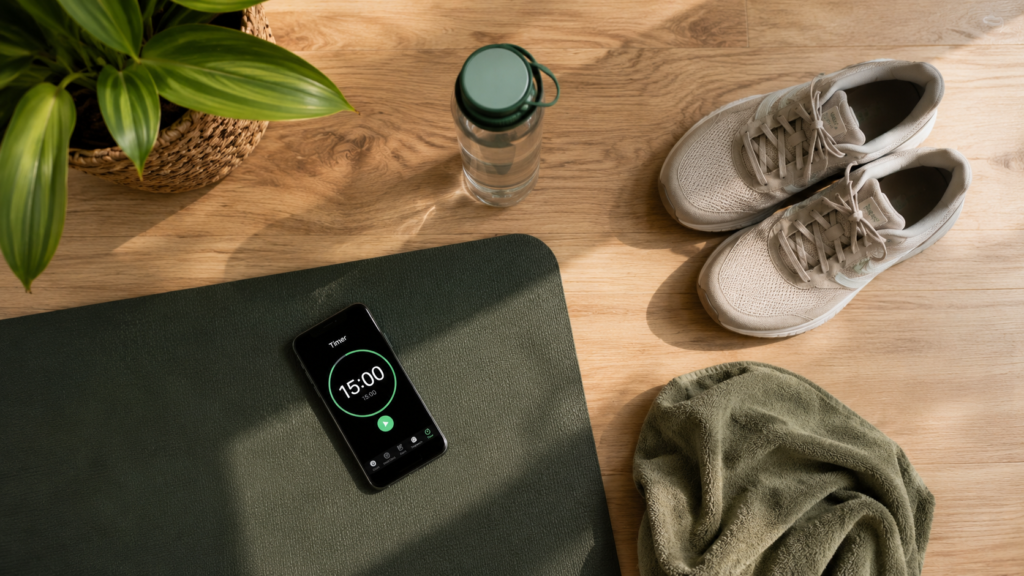
This is the actual routine I used during my first months of training, refined over two years of testing what works for absolute beginners.
Structure: 3 rounds of 5 exercises, with 30 seconds rest between exercises and 1 minute between rounds. Total time: about 14-15 minutes.
The 5 exercises in each round
| Exercise | Reps | Notes |
|---|---|---|
| Push-ups | 10-15 reps | Knees on floor if standard is too hard |
| Squats | 15-20 reps | Feet shoulder-width, chest up |
| Plank | 30-45 seconds | Hold solid; rest if you must |
| Reverse lunges | 10 per leg | Step backward, control descent |
| Mountain climbers | 20 per side | Steady pace, don’t flail |
How to run the workout
- Warm-up (1 minute): march in place, arm circles, gentle squats. Don’t skip — even short workouts need a warm-up.
- Round 1: complete each exercise back-to-back with 30 seconds of rest in between.
- Rest: 1 minute between rounds.
- Rounds 2 and 3: same as round 1.
- Cool-down (1 minute): 30-second standing quad stretch + 30-second standing hamstring stretch.
Fifteen minutes only works if you actually time it. Otherwise it’s “fifteen-ish” — which becomes twenty, then twenty-five, then never. You can use your phone, but I genuinely prefer a simple interval timer clipped to my shorts. Set the work/rest intervals once, hit start, and stop tapping the screen every 30 seconds. About $20 (the Gymboss is the classic), and it lasts forever. The single tool that turned my 15-minute workouts from “kinda did some stuff” into actual training.
A typical session timing
- Warm-up: 1 min
- Round 1: ~4 min (5 exercises + 4 rest periods of 30s)
- 1-min rest
- Round 2: ~4 min
- 1-min rest
- Round 3: ~4 min
- Cool-down: 1 min
Total: 15 minutes. Doable in your living room, your bedroom, a hotel room, or any patch of floor large enough to lie down.
Adjustments for absolute beginners
If 10 push-ups feels impossible on day one (it did for me), here’s how to scale:
- Push-ups too hard: start on your knees. Or hands on a wall. Aim for 5 reps the first week.
- Squats: can sit down to a chair and stand up. Same movement, less load.
- Plank: start at 20 seconds. Build up week by week.
- Lunges: hold a wall for balance if needed.
- Mountain climbers: slow them down. They’re cardio at any pace.
The point of the routine isn’t to crush yourself in week one — it’s to build the habit of moving daily.
How 15 Minutes Became 25 (My Real Story)
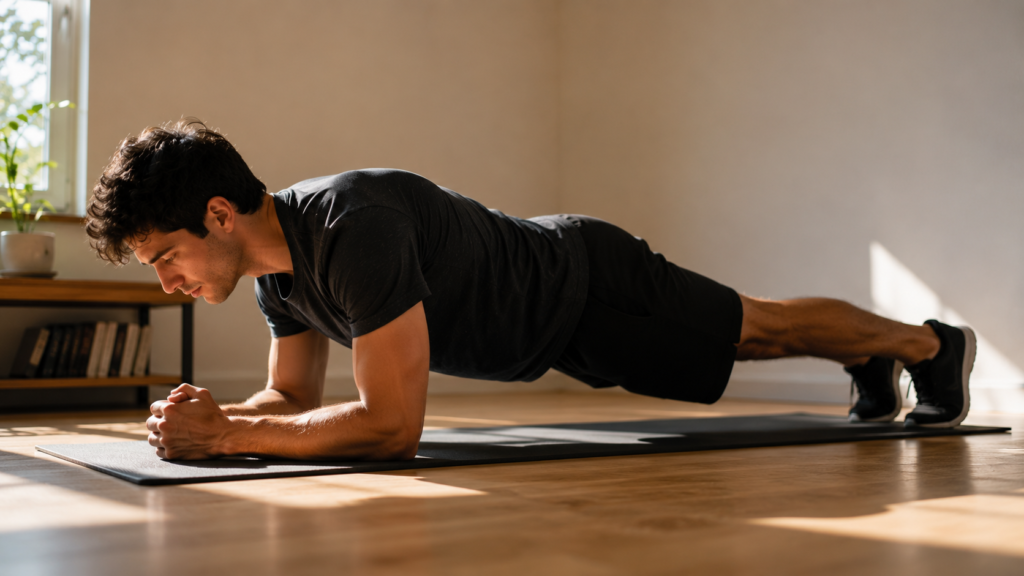
I want to be honest about what 15-minute workouts felt like in the first weeks, because nobody talks about this part.
The first time I trained for 15 minutes, I felt like nothing was happening. The session was over before my body even felt warm. I sweated a little, sure, but I walked away thinking “is this really enough?” Three sessions in, the doubt got louder. Five sessions in, I almost stopped.
Then something quietly shifted. By week three, my body started adapting in ways I didn’t expect. The 30-second plank that crushed me on day one felt manageable. The 10 push-ups I could barely finish became 15. And weirdly, my body started asking for more — I’d finish the 15-minute routine and find myself adding a fourth round, or extending the plank, or doing a few extra lunges.
By week six, those 15 minutes had organically grown to 20. By week eight, 25. Not because I forced it, but because the routine had become so embedded in my day that adding 5 minutes felt natural.
That’s the part most people miss. The 15-minute routine isn’t the destination — it’s the starting line for habit formation. The bigger sessions come naturally once the habit is solid. Trying to start with 60 minutes when you have no consistency is what causes 90% of beginners to quit by week three.
If at any point you outgrow the 15-minute structure and want a more progressive 4-week plan, my ultimate home workout plan for beginners shows the exact 4-week ramp that builds on top of this foundation.
Who 15-Minute Workouts Won’t Work For
I want to be upfront about the limits of this approach, because half-truths damage trust and you deserve the real picture.
This routine won’t work for you if:
- You want overnight results. No 15-minute routine produces dramatic body changes in 2-4 weeks. Real visible change takes 3-6 months of consistency.
- You can’t commit to consistency. If you do it twice and then disappear for a week, the math doesn’t work. The whole premise depends on showing up almost daily.
- You’re not sleeping or eating well. A 15-minute workout can’t compensate for 4 hours of sleep, ultra-processed food, and chronic stress. Recovery and nutrition are 60-70% of the result. The workout is the rest.
- You go through the motions without effort. If you do “push-ups” with your hips sagging to the floor and squats halfway down, 15 minutes really does become 15 minutes of waste. The intensity has to be honest.
- You want to compete in athletics or build serious muscle mass. Then 15-minute sessions are a starting point but not the whole picture — eventually you’ll need longer sessions, progressive loading, and more variety.
Who this routine works exceptionally well for:
- Complete beginners moving from sedentary to active.
- Busy professionals or parents who genuinely don’t have an hour.
- People returning to fitness after a long break (injury, illness, life chaos).
- Anyone who has tried longer routines and quit because they couldn’t sustain them.
- Travelers who want a hotel-room-friendly workout.
If you’re in the second list, this routine is one of the best things you can add to your life with zero financial cost.
The Mindset Shift That Makes 15 Minutes Stick
The biggest reason 15-minute workouts fail isn’t physical — it’s mental. People treat workouts as “events” that require the right time, the right clothes, the right energy, and the right gym setting. That mental framework destroys consistency.
Here’s the shift that worked for me, in three layers:
Layer 1 — Stop treating the workout as a big event
The moment I started seeing my 15-minute session as a normal part of my day — the same as brushing my teeth or showering — everything got easier. You don’t deliberate about whether to brush your teeth. You just do it because it’s part of the day. Make the workout boring in that same way. Strip away the ritual. No special clothes (sometimes I trained in whatever I was already wearing). No special location (anywhere with floor space). No special mood.
Layer 2 — Reduce the friction to start
Every decision you have to make before training is a chance to talk yourself out of it. Reduce them to zero:
- Pre-choose the exercises (don’t decide each day what to do — use the same 5)
- Set a roughly fixed time (mornings work best for most people, but anytime consistent works)
- Don’t wait for the “right” mood (waiting for motivation will kill the habit)
- Have a mat or just a floor ready (no setup that adds resistance)
Layer 3 — Show up on the bad days
The most important workouts I ever did were the ones I didn’t want to do. Days when I was tired, demotivated, slightly under the weather, or just busy. Those sessions weren’t my best, but they were the most valuable, because they’re what kept the chain unbroken.
Some days you’ll crush the 3 rounds with energy left over. Some days you’ll barely finish round 1. Both count. The habit isn’t about quality — it’s about presence. Show up. Do something. Move on.
Consistency doesn’t come from constant motivation. It comes from reducing excuses and making the habit so simple that you do it almost without thinking.
How to Set Up Your 15-Minute Routine
If you want to start this week, here’s the practical setup:
What you need
- A piece of floor (yoga mat helps but isn’t required)
- A water bottle (sweat happens)
- A phone with timer (your built-in clock app works fine, or use a free interval timer app like “Tabata Timer”)
- 15 minutes in your schedule, ideally at the same time each day
Recommended schedule
Aim for 3-5 sessions per week, with at least 1-2 rest days. Not every day. Your body needs recovery, especially in the first month.
A realistic starting schedule for a complete beginner:
| Day | Workout |
|---|---|
| Monday | 15-min routine |
| Tuesday | Walk or rest |
| Wednesday | 15-min routine |
| Thursday | Walk or rest |
| Friday | 15-min routine |
| Saturday | Light walk or rest |
| Sunday | Full rest |
Three workout days per week is plenty for week one. Add a 4th day in week 3-4 if you’re recovering well.
Track your progress (lightly)
Don’t track everything — that becomes a chore. Just log two simple metrics each session in a phone note:
- Reps of push-ups in your last round (this number will grow)
- Plank seconds in your last round (this number will grow)
After 4 weeks, look at the trend. The progress will surprise you.
A Real Week of 15-Minute Workouts
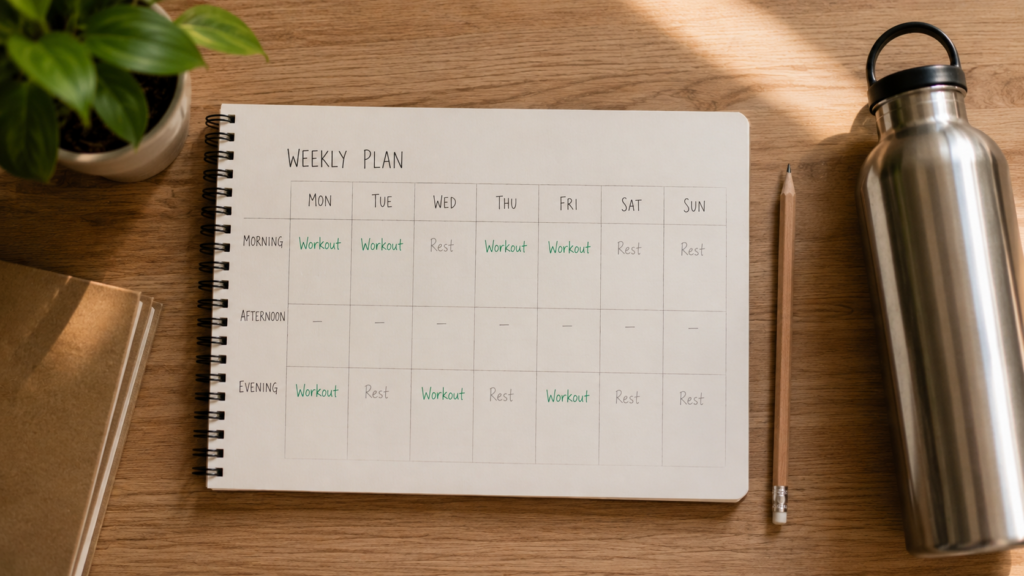
Here’s what a typical week of 15-minute home workouts looks like for someone applying this routine. Use as a template.
Monday — Full 3-round routine
You’re rested from the weekend, energy is fresh. Push slightly: aim for the upper end of reps (15 push-ups, 20 squats, 45-second plank). Total time: ~15 minutes.
Wednesday — Same routine, different intensity
Mid-week energy can dip. Take what your body gives you. If 10 push-ups is your limit today, do 10. Plank for 30s instead of 45. The structure matters more than the maximum effort.
Friday — Push a little, but don’t break form
End-of-week sessions are about closing the week strong, not breaking yourself. Stay honest with form. If round 3 is collapsing, drop to round 2 + a longer cool-down instead.
Tuesday, Thursday — Active recovery
These aren’t workout days. A 20-30 minute walk, some light stretching, or just being active in the day. Don’t sit for 8 hours straight, but don’t hit the floor for another workout. Your body needs to consolidate.
Saturday — Optional light session
If you feel like moving, do 2 rounds instead of 3 (about 10 minutes). Or replace with a longer walk or outdoor activity. Or rest fully. All three are correct.
Sunday — Full rest
No workout. Walk if you want. Plan the week ahead, meal prep, sleep extra. Recovery is part of training.
If your fitness improvements are part of a broader budget-conscious lifestyle, my complete guide to eating healthy on a budget covers the nutrition side that makes these short workouts actually translate into visible results.
What to Expect at 4 Weeks, 8 Weeks, and 12 Weeks
Realistic timeline based on what I and several people I’ve coached have experienced:
Week 1-2
You feel awkward. Soreness in places you forgot existed. Round 3 is brutal. Push-ups feel embarrassing. This is normal. Don’t quit. Don’t take photos yet. Just show up.
Week 3-4
The 30-second plank that crushed you in week 1 starts to feel doable. You can do 12-15 push-ups instead of 10. Clothes might fit a little differently. A friend who hasn’t seen you in 2-3 weeks might notice.
Week 5-8
Real visible change starts. The 15-minute routine has become automatic. Some days you naturally extend it to 20 because your body wants more. Mountain climbers stop being torture. You start considering longer routines on weekends.
Week 9-12
If you’ve been consistent, this is when the photos look different. People notice. Energy levels are visibly higher throughout the day. Sleep quality has likely improved. The 15-minute routine is now part of your life, not something you have to think about.
Frequently Asked Questions
Is 15 minutes really enough to get fit?
For absolute beginners moving from sedentary to active — yes. For 6-12 months of consistent training, 15-minute sessions paired with light walking on rest days produces real, visible results. After that, you’ll naturally outgrow it and want longer sessions.
How often should I do this 15-minute workout?
3-5 times per week, with at least 1-2 rest days. Daily training as a complete beginner usually leads to burnout or minor injury within a month.
Do I need any equipment at all?
No. Everything in this routine uses your bodyweight on the floor. If you want optional upgrades, a yoga mat (€10-20) protects your knees and back during planks and push-ups. That’s it.
Can I build muscle with only 15-minute workouts?
You can build some muscle, especially in the first 6-12 months. Muscle growth requires mechanical tension and progressive overload — both of which this routine provides for beginners. After your first year, you’ll need longer sessions or weights to keep progressing.
What if I can’t do a full plank or push-up yet?
Start with the easier version. Knee push-ups instead of standard. 10-second plank holds instead of 30. The routine works at every level — what matters is doing it consistently, not which variation you do.
When will I see results?
Honest timeline: small changes by week 4, visible changes by week 8, photo-ready changes by week 12. Earlier than that, the changes are mostly internal (energy, mood, sleep quality) — real but invisible. Don’t take “before” photos in week 1 and “after” photos in week 4 expecting transformation. Take them at weeks 1, 8, and 16.
What’s the difference between this 15-minute workout and a longer plan?
This 15-minute routine is the starting line — built around habit formation and absolute beginners. The 4-week home workout plan is the next step: structured progression with 25-35 minute sessions for when you’re ready to commit a bit more time. Many people stay on the 15-minute routine for 2-3 months before graduating to the longer plan.
Your Next Step
Stop planning. Start doing.
Tomorrow morning, set a 15-minute timer. Do the routine: warm-up, 3 rounds of push-ups + squats + plank + lunges + mountain climbers, cool-down. Don’t worry about form perfection. Don’t worry about how it compares to someone else. Just complete it.
Do it again Wednesday. And Friday. Week one, that’s all you do. Three sessions, fifteen minutes each.
In four weeks you’ll be a meaningfully different version of yourself, and the foundation of a real fitness practice will be in place.
When you’re ready for a longer structured plan, my ultimate home workout plan for beginners is the natural next step. And if you want the broader framework — workouts, food, mindset — that ties it all together, start with how to get fit on a budget.
You don’t need 60 minutes. You need 15 minutes you actually do.
— Gabriel Founder, Fit Budget Life