
Every Sunday afternoon I spend about three hours in my kitchen in Rio de Janeiro. I cook a pot of rice, simmer a pot of beans, roast a tray of chicken or fish, and chop enough vegetables for the next six days. By the time I’m done, I have eight glass meal-prep containers lined up on the counter — five lunches and three dinners to eat healthy — plus fruit and a couple of small snacks set aside for the rest of the week.
This article contains affiliate links. If you buy throughthese links, I may earn a small commission at no extra costto you. I only recommend products I personally use and trust.
That entire week of eating, including the snacks and the fruit, costs me around $20.
Before I worked out this system, I was spending more than $200 a month on food. Half of it on takeout and impulse buys. Half on groceries I never finished using. I felt heavier, lazier, and broker — three problems I assumed were unrelated until I realized they were all connected to the same broken habit: shopping and eating without a plan.
This guide is the system I built to fix it. No expensive specialty stores. No protein powders. No “superfoods” with markup. Just real food, smart shopping, and the structure I learned the hard way. If your goal is to eat healthy on a budget, this is how I do it — and how anyone with a kitchen and 3 hours of free time on a Sunday can do the same.
Why Most “Healthy Eating” Advice Fails on a Budget
The wellness industry sells a story: that healthy eating means organic-labeled groceries, exotic-sounding pantry items, and a Whole Foods receipt that doubles your monthly food bill. That story is great for the people selling those products. It’s terrible for the people trying to actually feed themselves well without going broke.
The reality, supported by every reputable health organization, is much simpler. According to the World Health Organization, a healthy diet helps protect against malnutrition and a wide range of chronic diseases — and the recommendations come down to: eat plenty of fruits and vegetables, choose whole grains, include enough protein, limit added sugar and saturated fat, drink water. None of that requires a $200 monthly markup over what regular food costs.
The pattern I noticed once I actually paid attention: most of my old “healthy eating” failures came not from lack of nutritional knowledge, but from lack of structure. I knew what I should eat. I just didn’t have a system for buying it, preparing it, or having it ready when I was hungry. The wellness industry doesn’t sell structure — they sell products. So that’s what I built first, before changing anything else about what I ate.
My $20-a-Week Meal Prep Formula
This is the entire system, summarized:
Every Sunday, three hours, eight containers, $20.
The investment that holds it all together: a good set of glass meal-prep containers. About $25 for 5 — and unlike plastic, they don’t stain, don’t absorb smells, and go straight from freezer to oven. Mine have lasted 2 years and counting. The single most-used kitchen item I own.
Each glass container holds:
- ~150g of protein (eggs, chicken, beef, or fish — whatever was cheapest at the market that week)
- ~150g of carbohydrate (white rice, pasta, or potatoes, rotated)
- ~80g of beans (cooked from dry beans I made earlier in the day)
- Salad on the side (lettuce, tomato, cucumber, carrots — whatever’s in season)
Quick honest detail: those “~150g” portions only work because I weigh them. I use a basic digital kitchen scale — $12, takes 3 seconds, lives on the counter. Before I had one, I was systematically overshooting rice and undershooting protein. The math of $20/week only works when you actually know the math.
That’s it. Eight versions of the same template, with small variations across the week so it doesn’t get boring. The salad is unlimited because vegetables almost never break a budget — what breaks budgets is the protein and the snacks.
What it actually costs
Roughly $20 per week for everything: the proteins, carbs, beans, vegetables, fruit, and a couple of small snacks. That works out to about $4 per meal per day, including the fruit between meals.
Compare that to a single takeout lunch in any major city — $8 to $15, easily — and the math is undeniable. You don’t even need to be frugal-minded to recognize the savings; you just need to eat lunch.
The hunger question (because it’s real)
I’ll be honest about something most “eat healthy on a budget” articles skip: in the first two or three weeks of switching to this kind of structured eating, I was hungry. Not starving — but visibly, persistently hungry between meals. I had been eating much larger portions before, mostly through unstructured snacking and second helpings, and my stomach had stretched to expect that.
What I expected to take six months took about three weeks. By week four, the same 150g of protein and 150g of carbs that had felt insufficient in week one were leaving me genuinely satisfied. The body adapts faster than people give it credit for. If you’re a few days in and feeling unsatisfied, that’s normal and temporary. Push through. It gets easy.
The 3-to-5-minute rule
The best part of meal prep isn’t the cost. It’s the friction-reduction. Every weekday morning, lunchtime, and evening, the most physical effort I put into my food is opening the fridge, transferring a container to a plate, and microwaving it for 3 to 5 minutes. That’s it.
This is what makes the system actually work. I don’t have time on a Tuesday at 12:45 to cook a balanced meal. I don’t have willpower at 7:30 p.m. when I’m tired and hungry. But I always have 3 minutes to reheat what past-me already cooked. The Sunday version of me makes the decisions for the rest of the week. Everyone else just executes them.
Smart Shopping Habits That Cut Your Bill in Half
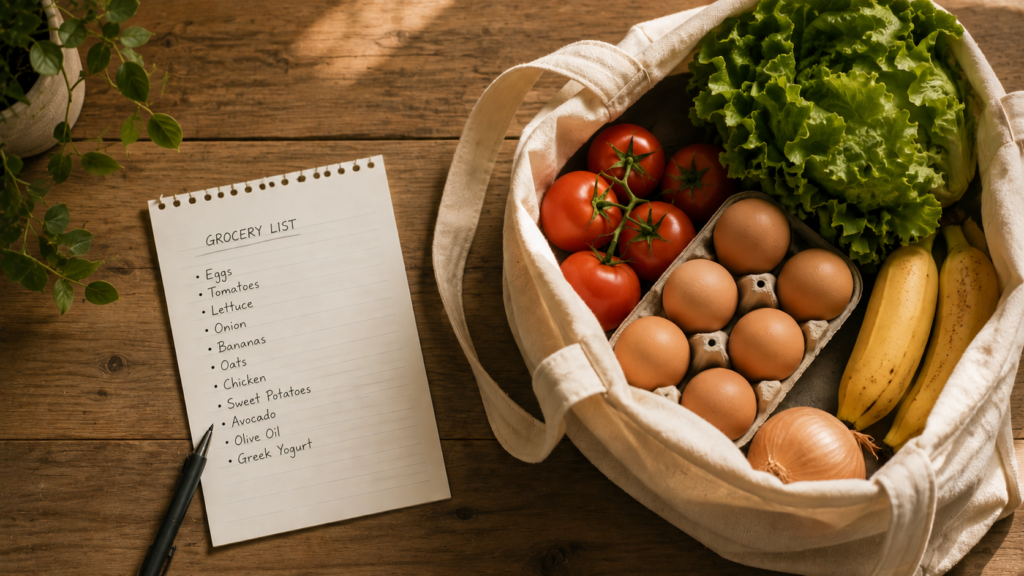
The $20-a-week number above isn’t an accident. It’s the result of three shopping habits that I’d argue matter more than any “healthy food list” you’ll ever read. The best budget healthy food choices in the world don’t help if your shopping habits keep draining your wallet on the way home.
Plan your meals before you shop. This single habit cut my food spending in half. I spend about ten minutes on Saturday writing out roughly what I’ll cook on Sunday — not a rigid schedule, just enough to know what to buy. Without this step I used to wander around the market grabbing things, and half of them ended up wasted.
Shop with a list and stick to it. Markets are designed to make you spend more than you intended. Eye-level products, end-of-aisle displays, the bakery scent at the entrance — all of it is engineered. Going in with a list and treating it as non-negotiable is the simplest way to neutralize that. My current grocery list covers exactly six days of meals — Monday to Saturday — plus the fruit I want to eat between meals. Anything not on the list doesn’t go in the cart.
Buy whole foods instead of pre-prepared versions. A whole chicken is dramatically cheaper per gram than chicken breasts. Dry beans are a fraction of the cost of canned. A block of cheese costs less than pre-shredded. Every step of preparation a manufacturer does for you is a markup. When you eat healthy on a budget, doing the chopping and cooking yourself is one of the most reliable ways to save.
Embrace frozen and canned produce when fresh isn’t seasonal. Frozen vegetables are picked at peak ripeness and frozen within hours. Often more nutritious than fresh produce that’s traveled across continents. Canned tomatoes, beans, corn — all genuinely good. Rinsing canned beans cuts most of the sodium. There’s no nutritional or budget reason to avoid them.
Bring your own reusable produce bags. At the market, I always bring a set of reusable produce bags — about $10 for 9 bags, lasts years. The mesh keeps vegetables fresher than plastic, looks intentional at checkout, and after a year of use they’ve already paid for themselves in plastic bag fees alone. Small detail, real impact over time.
The Cheap Nutritious Foods That Stay in My Cart
These are the actual foundations of my meal prep — the foods that show up on every grocery list, week after week. There’s nothing exotic here. Most of these have been part of healthy eating for centuries. They’re cheap because they’re available everywhere and produced at scale, not because they’re low-quality.
Rice and beans (the Brazilian foundation). I grew up eating rice and beans, and the more I learn about nutrition, the more I appreciate how good that foundation is. White rice and black beans together provide complete protein, complex carbs, fiber, iron, and folate. A pound of dry rice and a pound of dry beans together cost under $3 and feed me for a full week. If there’s one cheap nutritious foundation that powers everything else I cook, this is it.
Eggs. Versatile, complete protein, ridiculously cheap. I usually buy a dozen at a time and they last me about four days. Scrambled, hard-boiled, baked into a frittata, dropped on top of rice — eggs are the workhorse of cheap healthy meals. A single egg has all nine essential amino acids, plus B12, choline, and healthy fats. There’s a reason they’re a global staple.
Chicken thighs (and the occasional fish). Bone-in chicken thighs are dramatically cheaper than boneless skinless breasts and significantly more flavorful. I use them in my Sunday roast about three out of four weeks. The fourth week I rotate in a piece of cheap white fish or, occasionally, ground beef.
Rolled oats. A 1-kilogram bag of plain rolled oats costs about $2 and provides 30+ servings of breakfast. Add a banana and a spoonful of peanut butter and you have a filling, balanced meal for under 50 cents.
Frozen vegetables and seasonal produce. A bag of frozen spinach or mixed vegetables costs $1-2 and never goes to waste. For fresh, I focus on what’s seasonal and cheap: bananas year-round, oranges in winter, tomatoes and lettuce most of the year, sweet potatoes and carrots when they’re at their best.
Bread. Plain bread (not the labeled-organic-multi-seed-superfood variety) is one of the cheapest and most underrated staples. I use it specifically for one meal that I’ll get to in the next section.
Real Meals from My Real Kitchen (Under $2 Each)
These aren’t recipes pulled from a database. These are five things I actually eat, week in and week out, that I’d serve to a friend without apologizing.

Bread with Scrambled Eggs ($0.40 — and I’m not exaggerating)
This one isn’t going to win any food blog awards, but it’s the meal I refuse to remove from my diet — and I’ve tried more elaborate breakfast options. Bread with scrambled eggs. One whole bread roll cut in half. Two eggs scrambled with salt and a generous twist of black pepper. Pile the eggs onto both halves. Eat.
It costs about $0.40 per serving and takes 5 minutes from start to finish. It’s protein, carb, and enough fat to keep you satisfied. I eat this for breakfast multiple times a week, sometimes for an afternoon snack, and occasionally for a fast dinner when I’m too tired to think. If you’re starting a budget healthy eating habit and you want one anchor meal that you literally cannot fail to make, this is it.
Brazilian-Style Plate ($2.50, the foundation of my meal prep)
The plate I described in the formula above. Cooked rice, simmered black beans, a piece of seasoned chicken thigh or other protein, and a fresh salad on the side. This is what’s in 5 of my 8 weekly containers, with small variations.
To prep: cook a large pot of rice (about 500g dry rice goes a long way), simmer the beans for 90 minutes with garlic and a bay leaf, season the chicken with salt, garlic, and a squeeze of lime then bake it at 200°C for 30-35 minutes. Portion everything into containers as it cools. Salad ingredients stay fresh in the fridge whole and get assembled in the morning before work.
Spiced Red Lentil Soup ($1 a serving, freezes beautifully)
Sauté one diced onion and four garlic cloves in olive oil. Add two teaspoons each of cumin and smoked paprika, one can of crushed tomatoes, one cup of dry red lentils, and four cups of broth. Simmer for 25 minutes until the lentils have dissolved. Salt, lemon juice, and parsley to finish. Six servings at $1 each, freezes for up to three months.
Egg and Vegetable Frittata ($0.70 a slice)
Whisk 8 eggs with salt and pepper. Add any frozen or fresh vegetables you have on hand — spinach, onion, peppers, mushrooms. Pour into an oven-safe pan and bake at 190°C for 18 minutes. One frittata feeds 4-5 people and costs around $3 total. Cheap, fast, and high-protein. Goes great with bread and a salad.
Banana Oats ($0.40 a serving)
Plain rolled oats cooked in milk or water with a banana sliced in. A spoonful of peanut butter on top, a sprinkle of cinnamon. That’s it. The cheapest filling breakfast I know of, and one I make most weekday mornings when I’m not in the mood for eggs. Both of these are great pairs with a home workout plan for beginners — protein for the muscles, carbs for the energy.
How I Stopped Wasting $100 a Month at the Market
This was the single biggest financial change I made in my food life — and it had nothing to do with switching to cheaper ingredients. I just stopped buying things I didn’t need.
Before I had a system, my grocery shopping looked like this: walk into the market, walk down every aisle, pick up whatever caught my eye. A bag of cookies because I felt like a treat. A premium cut of meat because it looked good in the case. Six different snack items because I couldn’t decide which one I wanted. By the time I left, my cart had $60 of food, of which about $30 was things I’d bought on impulse. Most weeks I threw away food at the end because I had bought too much of the wrong things.
After: my list covers Monday to Saturday only. Each item has a specific purpose — it’s a protein for two days of meal prep, or it’s a snack for after my Wednesday workout, or it’s a fruit I’ll eat between meals. Anything that isn’t on the list, I don’t buy. If I genuinely want something extra, I add it to next week’s list.
The result, after I tracked it for two months: roughly $100 less per month in grocery spending, and almost zero food waste. I’m eating better, my fridge isn’t a graveyard of forgotten produce, and my bank account is happier. $100 a month is $1,200 a year. That’s a vacation. It’s an emergency fund built from nothing.
The shift wasn’t about becoming a stricter or more disciplined person. It was about removing the decision from the wrong moment. By Sunday afternoon I know exactly what I’m cooking that week. By Saturday morning I know exactly what I’m buying. The Saturday version of me has time and a clear head; the Wednesday-evening version of me does not.
How to Reduce Food Waste and Make Your Budget Go Further
Even with smart shopping, food waste sneaks in. In the average household, an estimated 30% of purchased food gets thrown away — a financial hit that quietly undermines every other healthy-budget effort. Three habits that helped me drop my own waste close to zero:
Cook in batches and reuse the components. Big pot of rice, big pot of beans, tray of roasted chicken — these aren’t dishes, they’re components. The same components show up in lunch on Monday, in a rice bowl with hot sauce on Wednesday, and rolled into a tortilla on Friday. Component cooking is what makes a small grocery list cover a whole week without anything spoiling.
First in, first out. When you put away groceries, move older items to the front of the fridge and put new ones in the back. It sounds too simple to matter — and it dramatically reduces forgotten produce.
Use scraps and almost-spoiled items aggressively. Wilting spinach goes into eggs. Overripe bananas go into oats or get frozen for smoothies. Broccoli stems are just as nutritious as the florets. Bread that’s getting stale gets toasted or turned into croutons. The parts of food that most people throw out can anchor entirely new meals.
Freeze before it goes bad. If I overbought protein, half goes in the freezer the same day I buy it. Cooked beans freeze. Soups freeze. Bread freezes. The freezer is the friend of the budget cook.
A Real Week of Eating on $20 (Monday to Saturday)
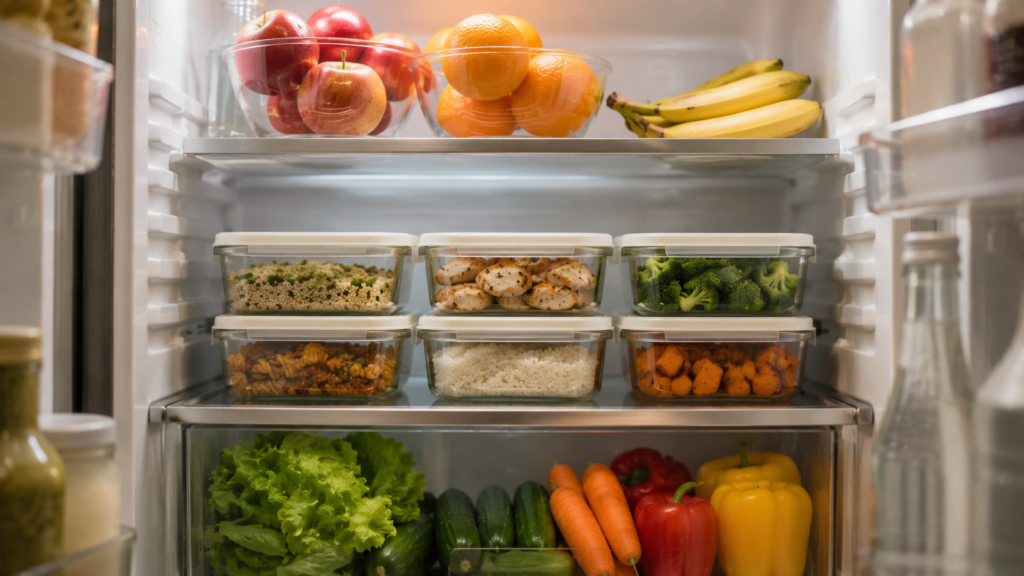
Here’s roughly what a typical week of eating looks like for me, built from the meal prep above. Sunday is the prep day; everything else is mostly reheating.
Monday breakfast: Banana oats. Lunch: Brazilian-style plate from Sunday’s prep. Dinner: same plate, different container. Snacks: an apple mid-morning, a piece of bread with eggs in the afternoon.
Tuesday breakfast: Bread with scrambled eggs. Lunch: Brazilian-style plate. Dinner: lentil soup (from Sunday’s prep). Snacks: an orange, a small handful of nuts.
Wednesday breakfast: Banana oats. Lunch: Brazilian-style plate. Dinner: frittata slice with bread and salad. Snacks: a banana before workout, an apple after.
Thursday breakfast: Bread with scrambled eggs. Lunch: Brazilian-style plate. Dinner: leftover frittata with vegetables. Snacks: a piece of fruit and a small yogurt.
Friday breakfast: Banana oats. Lunch: Brazilian-style plate. Dinner: lentil soup again or a fresh dinner (eggs, salad, bread). Snacks: fruit.
Saturday: Looser. Breakfast at home. Lunch and dinner are open — sometimes I eat out, sometimes I cook something new I want to try. The week’s structure is rigid Monday-to-Friday so that Saturday can be flexible without breaking anything.
That’s it. Roughly $20 in groceries. Five days of zero food decisions. One day of cooking. One day of free choice. The rhythm is what makes it work.
Making This Sustainable Long-Term
Here’s the part where most “eat healthy on a budget” articles wrap up with motivational vagueness, so I’ll be specific instead.
You don’t need perfect. I don’t follow this system 100% of the time. Some weeks I order delivery on a Wednesday because I’m exhausted. Some Saturdays I go out for ice cream. Once a month I cook something elaborate just for the joy of it. None of that has broken the system. The system survives because most of my weeks follow it, not because every single week does.
You don’t need the same meals forever. Variety comes from rotation, not from never repeating. The Brazilian-style plate doesn’t get old when you alternate the protein each week, change the vegetables, swap the sauce. The same template, executed slightly differently, never feels boring.
You don’t need to be a great cook. None of these meals require any technique beyond chopping, simmering, and timing things in the oven. If you can boil water and crack an egg, you can do all of this.
You don’t need to convince anyone. People will sometimes ask if you’re “on a diet” when you start eating this way. You’re not. You’re just eating well, cheaply, and consistently. That’s not a diet — it’s a sustainable habit.
If your weekly cooking time is the bottleneck, my cheap meal prep guide for beginners goes deeper into the Sunday system. And if you’re combining better nutrition with rebuilding your overall fitness, that’s covered in how to get fit on a budget — the full framework for getting healthy without overspending.
Frequently Asked Questions
Can you really eat healthy on $20 a week?
Yes — for one person, it’s not just possible, it’s normal once you have the system in place. My weekly grocery cost has been steady at $18-22 for months. The keys are: cook from scratch, rotate proteins (eggs, chicken, beans, occasional fish), embrace rice and beans as your foundation, plan before you shop. If you’re feeding a family, scale up linearly — not exponentially.
Are frozen vegetables actually as nutritious as fresh?
In most cases, yes — and sometimes more. Frozen vegetables are picked and frozen at peak ripeness. Fresh produce shipped from far away can lose significant nutritional value during transit and storage. For an affordable healthy diet, frozen vegetables are a clear win.
What are the cheapest sources of protein?
Eggs, dry beans, and lentils are unbeatable for protein per euro. Bone-in chicken thighs are the cheapest meat protein for me. Canned tuna and sardines deliver excellent protein and omega-3 fatty acids cheaply. Plain Greek yogurt on sale is a great option too.
How do I avoid getting bored eating the same cheap healthy meals?
Rotate the seasoning more than the ingredient. The same chicken tastes different with garlic and lime versus cumin and paprika versus soy and ginger. Build a small spice arsenal and your core meals will never feel repetitive.
Do I need to buy organic?
Not for a healthy diet on a budget. The nutritional gap between organic and conventional produce is small, and the price gap is large. Buying more vegetables in general matters more than buying organic versions of fewer of them.
Can I eat healthy on a budget as a family?
Yes, and bulk cooking gets even more efficient with more mouths to feed. Lentil soup, bean stews, and frittatas scale beautifully. Buying staples in larger quantities reduces the per-serving cost further. Families that batch cook two or three times a week often spend significantly less per meal than those who cook fresh daily.
Your Next Step
You don’t need to overhaul your entire pantry tomorrow. The fastest way to start is one habit at a time:
- This Saturday: Write a grocery list before you go shopping. Cover only the next six days.
- This Sunday: Cook one large pot of rice and one large pot of beans. That alone covers the foundation of five lunches.
- By next week: Add a Sunday roast (chicken thighs, ~30 minutes in the oven) and you have your week of meal prep.
Three weeks of doing this and the rhythm becomes automatic. Three months in, you’ll wonder why you ever did it differently.
If your bottleneck is the time investment of meal prep itself, read the cheap meal prep guide for beginners next. If you’re still figuring out the broader fitness side, how to get fit on a budget is the parent guide that ties it all together.
Eating well shouldn’t be expensive, complicated, or stressful. With a little structure on a Sunday afternoon, it doesn’t have to be any of those things.
— Gabriel Founder, Fit Budget Life
Pingback: Cheap Meal Prep for Beginners (Save Time & Money)